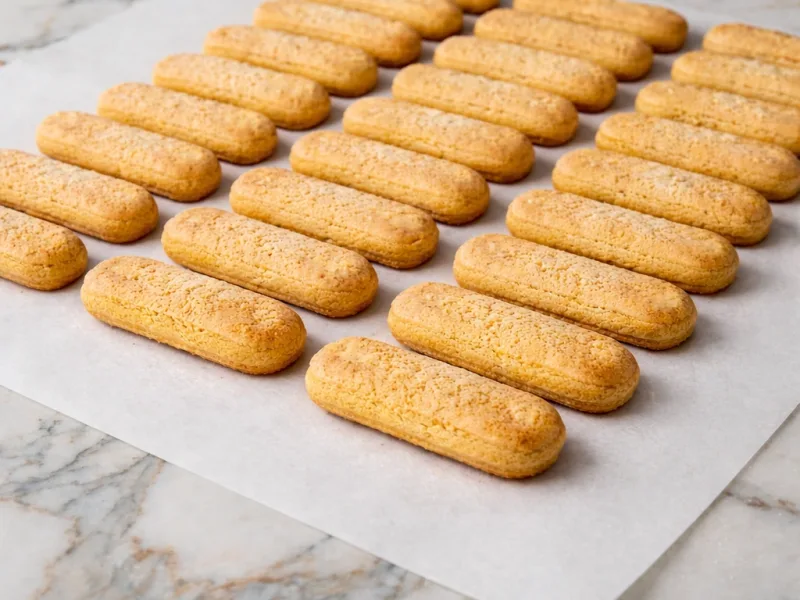
Base recipe: 30 savoiardi cookies
Your kitchen companion
Ingredients
Check off ingredients as you prepare them.
Follow the steps at your own pace.
Method
Separate eggs: Separate 5 large eggs (250 g without shells) into whites and yolks using two clean mixing bowls; ensure no yolk contaminates the whites to allow proper aeration.
Whip egg whites: Add 1/4 tsp (1 g) fine salt to the egg whites and beat with an electric mixer on medium speed; gradually add 3/8 cup (75 g) granulated sugar and continue until stiff, glossy peaks form that hold shape when lifted.
Whip egg yolks: Combine the yolks with 3/8 cup (75 g) granulated sugar and 1 tsp (5 g) vanilla sugar; mix with a hand mixer on medium-high speed until pale, thick, and forming ribbons that slowly dissolve on the surface.
Combine mixtures: Fold the yolk mixture into the whipped whites using a silicone spatula; lift and turn gently to preserve volume and avoid deflation.
Add dry ingredients: Sift 1 cup (120 g) all-purpose flour and 3 tbsp (25 g) corn starch together; fold into the batter in two additions until smooth with no visible dry flour.
Pipe batter: Transfer the batter into a piping bag fitted with a 1 cm (0.4 inch) round tip; pipe 10 cm (4 inch) long strips onto a 40 × 30 cm (16 × 12 inch) parchment-lined baking tray, leaving space between each strip.
Bake cookies: Place the tray in a preheated oven at 356°F (180°C), static mode, middle rack; bake for 12–14 minutes until lightly golden and the surface feels dry and firm when touched.
Cool cookies: Remove from oven and allow cookies to cool on the tray for 10 minutes; transfer to a wire rack to prevent moisture buildup and maintain a dry structure.
Dry cookies: Leave cookies uncovered at room temperature for 12–24 hours; this step reduces internal moisture and ensures proper absorption for tiramisu layering.
Extra technique, safety notes and details when you want to go deeper.
More tips & details
The Secret to Professional Ladyfinger Sponge
Mastering Dry Savoiardi for Stable Dessert Layers
These light and crisp biscuits form the structural base for the classic tiramisu recipe, where stability and controlled absorption are essential. Unlike standard cookies, these Savoiardi cookies serve a purely functional role. Their job isn't just to be sweet; it is to provide a reliable architecture for your dessert. A perfect ladyfinger must drink up the espresso quickly while remaining completely intact—a quality we chefs describe as "holding its shape." You achieve this by creating a dry exterior and a light, airy interior that allows for balanced moisture across every single layer.
A dry exterior ensures the perfect bake
A properly baked batch should greet you with a firm, matte surface and no residual stickiness. When you bake these at 356°F (180°C), the heat drives off surface moisture to set the outer structure. You’ll know you’re on the right track when the biscuit feels sand-dry to the touch and leaves no residue on your fingers. This dry shell is your insurance policy; it prevents the biscuit from collapsing the moment it touches liquid, giving you a predictable, professional result every time you assemble your dessert.
Airy interiors for effortless coffee soaking
The magic happens inside the crumb. It should stay light and slightly dry, filled with tiny, evenly distributed air pockets. This structure creates a "capillary action," pulling in the coffee or liqueur evenly without leaving any dense, soggy spots. We are looking for a refined sponge texture that softens uniformly while keeping its form. A reliable indicator of success is a clean break when you snap a cookie in half—it should sound crisp, not soft or doughy.
Uniform sizing for beautiful dessert layers
Consistency is your best friend in the kitchen. When you pipe your batter into uniform 4-inch (10 cm) strips, you create even layers that reduce gaps in your serving dish. Straight edges and a consistent thickness of about 0.6 inches (1.5 cm) allow the biscuits to align perfectly. This ensures that every piece in your batch absorbs liquid at the same rate, avoiding the frustration of having one soggy biscuit next to one that is still bone-dry.
Why skipping the sugar coating improves texture
In this specialized version, we omit the powdered sugar dusting. Without that sugar crust, the porous surface is directly exposed to the air during baking and resting. This leads to a more consistent drying pattern and a much more predictable absorption rate. By removing the "sugar barrier," you allow the espresso to penetrate the sponge instantly and evenly, giving you total control over the final texture of your dessert.
Success targets for the perfect Savoiardi
- Surface condition: A bone-dry, matte exterior with no visible coating, showing proper dehydration.
- Internal crumb: A fine, airy structure that snaps cleanly rather than compressing under your fingers.
- Absorption: A gradual, even softening that holds its shape without disintegrating during the soak.
Chef PEKIS recommendations for structure
To master this recipe, maintain even piping pressure to ensure every cookie is the same thickness; variations will lead to some drying faster than others. Don’t be tempted to pull them out of the oven too early. If they haven't lost enough moisture, they will collapse into a mess when soaked. Finally, give them plenty of fresh air exposure after baking. Residual humidity is the enemy of a strong internal structure.
Storage and advance preparation tips
These dry sponge biscuits are a dream for make-ahead prep. You can store them at room temperature in a dry spot for up to three days. Just make sure they have continuous airflow to keep them crisp. Never tuck them into a container while they are still warm; trapped steam will soften the structure and ruin that perfect absorption performance we worked so hard to achieve.
Served alongside coffee and layered desserts
Savoiardi cookies, a baked sponge biscuit without any coating, present a dry, lightly crisp surface that softens quickly when paired with coffee or cream. On the plate, they hold a straight, defined shape, with a pale golden tone that signals proper baking. When placed into a dessert, the biscuit absorbs just enough liquid to become tender while maintaining its structure, creating clean layers without breaking apart.
At the table, these biscuits fit naturally into a dessert setting where multiple textures meet. They are often arranged in rows or stacked lightly, ready to be dipped or layered. The first bite reveals a contrast between the outer shell and the interior, which transitions into a soft sponge as it absorbs moisture. This balance allows the biscuit to carry flavors without becoming heavy or dense.
Texture holds during soaking and serving
The defining characteristic is the firm exterior with an airy interior, which responds predictably when exposed to liquid. A properly prepared batch softens evenly, without collapsing or turning pasty. This consistency becomes noticeable when serving layered desserts, where each portion keeps its shape when cut and lifted.
In a shared setting, the biscuits contribute structure rather than sweetness, supporting cream and coffee elements without overpowering them. They are best presented once they have absorbed flavor but before they lose their internal integrity, ensuring each portion remains clean and stable on the plate.
Questions
Why do savoiardi cookies turn soggy in tiramisu layers?
Sogginess occurs when cookies are under-dried and absorb liquid too fast. A properly baked and rested biscuit has a dry outer shell and a porous interior, allowing gradual absorption instead of collapse. Excess moisture inside the crumb leads to rapid breakdown and mushy layers. The correct condition is a cookie that softens evenly while still holding its shape. Chef tip: always leave the batch uncovered overnight to ensure full moisture evaporation.
Can savoiardi cookies be made without gluten and still stay firm?
Loss of firmness happens because gluten provides structural support during baking. Without it, the foam-based batter becomes more fragile and prone to collapse. A gluten-free version requires a balanced flour blend with starch to maintain some structure. The result remains usable but noticeably more delicate, with a softer bite and reduced resistance when soaked.
Why are homemade savoiardi cookies dense instead of light and airy?
Density is caused by insufficiently whipped egg whites or overmixing during folding. Air trapped in the foam is the primary structure, and losing it results in a compact crumb. A correct batter holds volume and appears thick but light when piped. The finished biscuit should feel light in hand and break cleanly rather than compressing.
What causes savoiardi cookies to spread instead of holding shape?
Spreading happens when the batter lacks structure due to weak foam or excess mixing. If the egg whites are not whipped to stiff peaks, the mixture cannot support its shape during piping and baking. The correct batter forms defined strips that remain stable before entering the oven. This ensures uniform size and even drying. Chef tip: stop folding immediately once the flour is incorporated to prevent deflation.
Why are savoiardi cookies too soft even after baking?
Softness after baking indicates incomplete moisture loss. If the surface remains flexible, the interior still contains excess water, preventing proper drying. The correct result is a firm, dry surface with a slightly crisp feel. Extended resting at room temperature allows remaining moisture to evaporate, stabilizing the structure for soaking.
Recivelle · /recipe/soft-light-savoiardi-cookies-tiramisu