Base recipe: 8 servings
Your kitchen companion
Ingredients
Check off ingredients as you prepare them.
Follow the steps at your own pace.
Method
1. Prepare the coffee soak
Brew ¾ cup (180 ml) of mild coffee and let it cool completely to room temperature, around 68–72°F (20–22°C). It’s crucial the coffee isn't warm; we want to soften the biscuits, not melt your luxurious cream.
2. Whip the "One-Bowl" cream
In a large chilled bowl, combine 8.8 oz (250 g) mascarpone, ¾ cup + 1 tbsp (200 ml) heavy cream, ⅓ cup (70 g) sugar, 1 tsp (5 ml) vanilla, a pinch of salt, and ½ cup (120 g) pistachio cream. Mix with a hand mixer for 2–3 minutes. Stop as soon as the mixture looks smooth, thick, and holds a soft shape on the whisk—it should look like a rich, pale green velvet with no lumps.
3. The "Flash-Dip" technique
Take your 7 oz (200 g) savoiardi and dip each ladyfinger into the cooled coffee for exactly 1 second. The surface should darken to a rich mahogany but the biscuit must stay firm to the touch. If it feels mushy, you’ve dipped too long!
4. Build the foundation
Lay the dipped ladyfingers in your 8 × 8 inch (20 × 20 cm) dish. Pack them in tightly to cover the entire base—this solid foundation is the secret to those clean, professional slices.
5. Layer the pistachio cream
Dollop half of your pistachio cream over the biscuits. Using a spatula, sweep it across the surface until it’s perfectly level and reaches every corner.
6. Repeat for height
Briefly dip the remaining ladyfingers and create a second layer. Align them directly on top of the first row to ensure your 7 x 7 cm squares remain stable when you cut into them later.
7. The final smooth
Spread the rest of the cream over the top. Use your spatula to create a smooth, consistent finish. Don’t worry about perfection—slight "chef’s marks" on the surface add an authentic, hand-finished charm.
8. The "Patience" chill
Tuck your tiramisu into the fridge at 39°F (4°C) for at least 6 hours (360 minutes). This is where the magic happens: the fats solidify, the flavors marry, and the biscuits reach that perfect, cake-like texture. It’s ready when the edges look sharp and set.
9. The pistachio finish
Just before serving, dust the top with 1 oz (30 g) of finely ground pistachios. This adds a vibrant green pop and a fresh, nutty crunch that contrasts beautifully with the silky layers.
Extra technique, safety notes and details when you want to go deeper.
More tips & details
Creamy pistachio tiramisu with stable layers for slicing
Balanced nut flavor with soft, structured layers
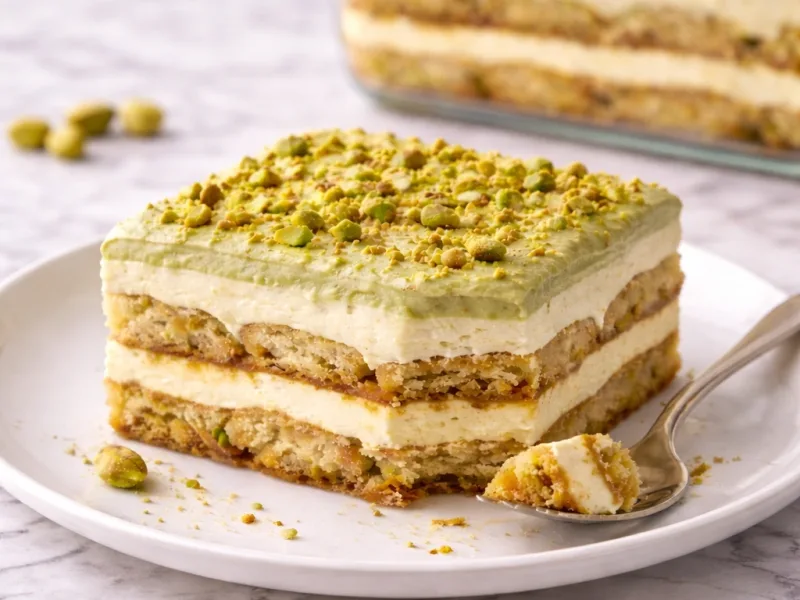
This beginner-friendly pistachio tiramisu builds directly on the structure of a classic Italian tiramisu with creamy layers, utilizing the same iconic layering logic while luxury-elevating the flavor profile toward a concentrated pistachio cream. This refined dessert is specifically engineered so the filling holds its elegant shape after chilling, cutting cleanly into defined, bistro-style portions. You will know your preparation is perfect when the top surface remains smooth but slightly textured after setting in an 8 x 8 inch (20 x 20 cm) pan, with zero liquid separation.
Master the structure: Stable layers that slice with precision
The secret to this dessert’s architecture lies in a strictly controlled moisture balance between the luscious cream and the soaked biscuits. When correctly assembled, the interior becomes tender and melt-in-the-mouth, yet maintains firm resistance when sliced. The dessert stabilizes during a minimum 6-hour refrigeration at 39°F (4°C), where fat solidification supports clean, sharp edges. This creates a no-bake pistachio tiramisu with mascarpone that maintains its structural integrity without the need for gelatin or artificial stabilizers.
Coffee absorption: Achieving controlled softness without collapse
Each ladyfinger (savoiardi) must absorb exactly enough liquid to soften into a cake-like texture without dissolving into a soggy mess. For this beginner version, we use 6 fl oz (180 ml) of mild, cooled coffee. The optimal state is achieved when the biscuits show a beautiful color variation rather than uniform, heavy saturation. This prevents structural collapse and keeps the base intact; while excess soaking leads to compression, a quick dip ensures the perfect layer definition and a light, airy bite.
Flavor profile: A sophisticated balance of nut and dairy
While the 4.2 oz (120 g) of sweetened pistachio cream introduces rich fats and sweetness, the true chef’s balance is achieved through the bitterness of mild coffee and a small pinch of salt (1 g). The final taste is round and decadent, with the pistachio remaining dominant without masking the delicate dairy base of the 8.8 oz (250 g) of mascarpone. This results in an easy pistachio tiramisu recipe that provides a high-end sensory experience—smelling of roasted nuts and fresh cream—suitable for any gathering.
Chef PEKIS recommendations for a professional finish
For a consistent, elite texture, keep your mascarpone and heavy cream cold—ideally 39°F (4°C)—before mixing; warmer ingredients reduce stability and lead to a softer, less defined cut. Use a one-bowl method and mix only until the cream thickens; overmixing introduces excess air, which can cause the layers to sag after chilling. When dipping your ladyfingers, remember that a 1-second dip is all you need to preserve the structure and prevent a soggy base.
Resting and timing: Why this dessert must be made ahead
To achieve the best results, this tiramisu must rest. Store it covered in the refrigerator for at least 6 to 8 hours, though 24 hours is the "sweet spot" where flavors fully integrate and the layers reach maximum stability. Beyond 24 hours, moisture migration begins to soften the biscuits further. Crucially, do not freeze this dish; thawing breaks the delicate emulsion of the cream and will cause the layers to separate.
Served chilled with defined, creamy layers
Pistachio tiramisu appears as a chilled, no-bake layered dessert, where each portion holds its shape from the first cut to the plate. The surface shows slight spatula marks, and the interior reveals clean, even layers with a soft but stable texture. When served, the cream remains smooth without pooling, and the biscuit layer stays integrated rather than separating.
The first bite delivers a balanced contrast: mild coffee notes followed by a nut-forward cream that spreads evenly across the palate. The texture should feel dense yet soft, without air pockets or graininess. A correct result is noticeable when the cream dissolves smoothly while the base offers light resistance.
Suitable for plated desserts and shared portions
This format fits naturally into small gatherings or plated service, where portions are cut into uniform squares and served directly. Each piece maintains structure when transferred, allowing for precise presentation without collapse. The dessert works well after a main meal, where a cooler, softer texture provides contrast to heavier dishes.
Seasonally, it adapts well to both warmer and transitional periods, as it is served cold and does not rely on heat-based preparation. The flavor remains stable over time, and the surface retains its finish without drying. A properly prepared piece shows defined edges and stable height, confirming that the internal structure has fully set and is ready for serving.
Questions
Can pistachio tiramisu be made without eggs safely?
Egg-free structure works because mascarpone and cream provide sufficient fat stability when chilled correctly. By skipping the eggs, we’re actually making your life easier—there’s zero risk of salmonella and a much lower chance of the cream "breaking" or separating on you. This "clean" base allows the pistachio flavor to truly shine through. Just stick to high-quality, full-fat ingredients; the fat is what does the heavy lifting to keep those layers tall and proud. Chef's Tip: If your mascarpone has a little liquid on top when you open it, drain it off completely before mixing to prevent your cream from thinning out.
Why does pistachio tiramisu become too soft or collapse when cut?
Excess liquid absorption in biscuits causes structural collapse and compresses the layers. Think of the ladyfinger like a sponge—if it’s fully saturated, it loses its "skeleton" and turns into mush under the weight of the cream. You want a lightning-fast dip. The center of the biscuit should actually still feel a bit dry when you lay it in the pan; it will soften to a perfect cake-like texture as it pulls moisture from the cream during its long rest in the fridge. Chef's Tip: Use a shallow, wide bowl for your coffee dip rather than a mug; it allows you to drop the biscuit in horizontally for a perfectly even, one-second coating.
What causes grainy or split cream in pistachio tiramisu layers?
Overmixing or temperature imbalance causes fat separation and grainy texture in the cream. Mascarpone is a delicate soul—if it gets too warm or you beat it like a rug, the fat molecules clump together and turn "grainy." We want a smooth, velvet-like emulsion. Keep everything—the bowl, the whisk, and the dairy—chilled until the very second you are ready to mix. Chef's Tip: If you see the cream just starting to look grainy, stop mixing immediately and fold in a tablespoon of cold, un-whipped heavy cream by hand to smooth it back out.
How to balance pistachio flavor without overpowering tiramisu base?
Excess pistachio cream masks the dairy base and creates overly sweet flavor. In the professional kitchen, we look for "roundness" in flavor. If you add too much nut paste, you lose the tang of the mascarpone and the punch of the coffee, leaving you with a dessert that's just sugary. By following my specific ratios and adding that tiny pinch of salt, you’re "lifting" the nut flavor so it tastes more like fresh pistachios and less like candy. Chef's Tip: To double down on the pistachio aroma without adding more sugar, lightly toast your garnish pistachios in a dry pan for 2 minutes before grinding them.
Why are tiramisu layers uneven or sliding during cutting?
Uneven layering or insufficient chilling prevents proper structural bonding between layers. This is often just a case of "baker's impatience!" When you spread your cream, use a small offset spatula to push it right into the corners so the height is uniform across the whole pan. If one side is higher than the other, the weight will cause the dessert to "drift" when sliced. Most importantly, give it the full 6–8 hours to set; the fats need that time to turn into a solid "glue." Chef's Tip: For those surgical, "clean-edge" slices you see in my photos, dip your knife in hot water and wipe it dry between every single cut.
Recivelle · /recipe/pistachio-tiramisu-creamiest-italian-dessert-ever