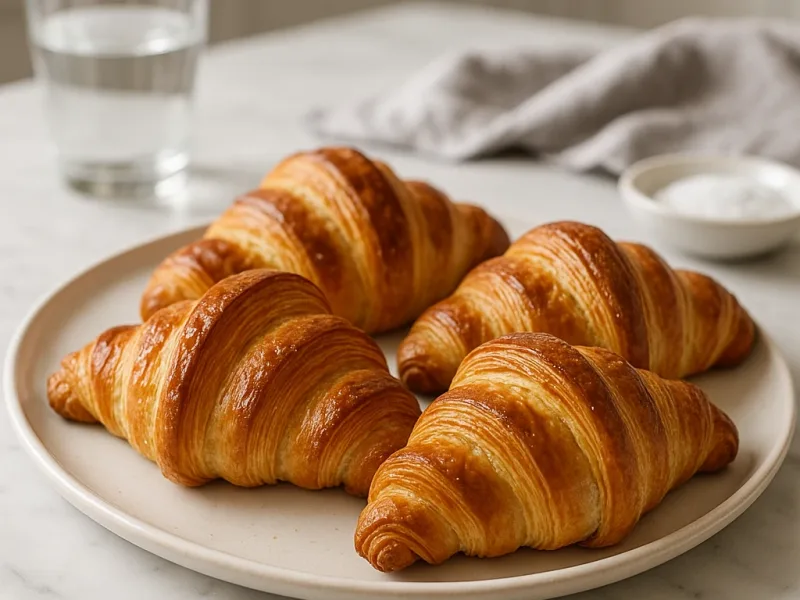
Base recipe: 4 croissants
Your kitchen companion
Ingredients
Check off ingredients as you prepare them.
Follow the steps at your own pace.
Method
Mix the dough: Add 1.75 cups (220 g) all-purpose flour, 2 tbsp (25 g) granulated sugar, 3/4 tsp (4.5 g) fine salt, and 1.25 tsp (4 g) instant yeast to a medium mixing bowl. Whisk until evenly combined. Pour in 3/4 cup (180 ml) cold whole milk and add 1 tbsp (15 g) softened unsalted butter. Mix on low speed using a stand mixer with a dough hook for 3 minutes. The dough will look shaggy but evenly hydrated.
Knead the dough: Increase mixer speed to medium and knead for 4 minutes. The dough will become smooth and elastic. Touch the surface: it should feel soft and slightly tacky, not sticky. If it seems dry, add 1 tbsp more milk (15 ml). Shape into a flat rectangle about 2 cm thick.
First chilling: Wrap the dough tightly in plastic wrap. Refrigerate for 90 minutes. This step relaxes gluten and keeps butter from melting during lamination.
Prepare the butter block: Place 3/4 cup (170 g) cold unsalted butter between two sheets of parchment paper. Pound with a rolling pin into a 6 × 7 inch (15 × 18 cm) rectangle. The butter should bend without cracking but stay cold. Refrigerate for 15 minutes if it softens.
Enclose the butter: Roll the chilled dough into a 9 × 14 inch (23 × 36 cm) rectangle on a lightly floured surface. Place the butter block in the center. Fold the dough over the butter and seal all edges firmly. Press seams gently. No butter should be visible.
First fold (single turn): Roll the dough into an 8 × 20 inch (20 × 50 cm) rectangle using even pressure. Fold into thirds like a letter. Brush off excess flour. Wrap and refrigerate for 45 minutes. The dough should feel cool and firm.
Second fold: Rotate the dough 90 degrees. Roll again to 8 × 20 inches (20 × 50 cm). Fold into thirds. Wrap and refrigerate for 45 minutes. You should see clean layers along the edges.
Third fold: Repeat rolling and folding one final time. Wrap tightly and refrigerate for 90 minutes. This resting time ensures clear, flaky layers.
Shape the croissants: Roll the dough into an 8 × 22 inch (20 × 55 cm) rectangle, about 3 mm thick. Cut into 4 long triangles using a sharp knife. Gently stretch each triangle. Roll from the wide base toward the tip, keeping tension even. Curve slightly into a crescent shape.
Final rise: Place croissants on a baking tray lined with parchment paper, spaced at least 6 cm apart. Cover loosely. Let rise at 75°F (24°C) for 120 minutes. They should look visibly puffy and jiggle slightly when the tray is tapped.
Egg wash: Whisk 1 large egg (55 g) with 1 tbsp milk (15 ml). Brush gently over the croissants using a soft brush. Avoid dripping egg wash between layers, which can prevent proper rise.
Bake: Bake in a preheated oven at 390°F (200°C), conventional heat, for 20–22 minutes. Croissants should be deep golden brown with clearly defined layers. If not golden yet, bake 2 minutes longer.
Cooling: Transfer to a wire rack and cool for 15 minutes. Cooling allows steam to escape and prevents a soggy bottom.
Extra technique, safety notes and details when you want to go deeper.
More tips & details
Mastering the Art of Homemade Croissants
A deep dive into flaky layers, butter aroma, and classic French technique
Homemade croissants represent the pinnacle of classic French baking, where patience, precision, and quality ingredients come together to create unmistakable flaky layers, a rich buttery aroma, and a tender, honeycombed interior. The appeal of a homemade croissant recipe lies not only in the final result, but in the process itself: folding, resting, rolling, and baking until simple dough transforms into a bakery-style pastry with depth, character, and elegance.
Butter plays a defining role in croissants, shaping both flavor and structure. As the dough bakes, steam forms between the laminated layers, creating lift and that sought-after shatteringly crisp exterior. Flour provides strength without toughness, while yeast quietly develops flavor during slow fermentation. Salt sharpens the buttery notes, and time does the rest. Each element has a purpose, and when handled correctly, the result is a croissant that tastes authentic, balanced, and deeply satisfying.
Croissants originated in France in the early 19th century, inspired by Austrian kipferl but refined through French technique and butter-rich dough. Over time, they became a symbol of French breakfast culture, enjoyed fresh in the morning with coffee or filled with chocolate, almond cream, or ham and cheese. Making them at home connects modern kitchens with centuries of artisanal tradition, turning a familiar pastry into a rewarding culinary project.
Why you’ll love this recipe
- True bakery-style results with crisp layers and soft interiors
- A method that emphasizes flavor development and structure, not shortcuts
- Ideal for weekend baking projects or special breakfasts
- A versatile base for sweet or savory croissant variations
- Deep satisfaction from mastering a professional pastry technique
Why this method works
- Slow fermentation enhances aroma, texture, and digestibility
- Proper lamination ensures even butter distribution
- Controlled resting relaxes gluten, preventing shrinkage
- High baking heat maximizes oven spring and flakiness
Chef’s tips
- Use high-quality butter with good plasticity for clean layers
- Keep the dough cool at every stage to avoid butter melting into the dough
- Light flouring prevents sticking without drying the dough
- Sharp, decisive cuts preserve the laminated structure
Common mistakes
- Overworking the dough, leading to toughness
- Rushing rest times, which compromises layering
- Letting butter soften too much during lamination
- Baking at too low a temperature, resulting in dense croissants
Storage and make-ahead
Croissants are best enjoyed fresh, but they are well suited to make-ahead preparation. Shaped, unbaked croissants can be frozen and baked straight from frozen with a slightly longer baking time. Fully baked croissants keep well at room temperature for a short time and can be refreshed in a hot oven to restore crispness. Avoid refrigeration, as it dulls flavor and texture. For planning ahead, preparing the dough over two days allows better control and improved results.
A great croissant often inspires further exploration. French baking is full of butter-rich classics and comforting breads that reward careful technique. Taking time to discover related recipes can deepen skills and spark new ideas in the kitchen.
For a lighter French classic with the same buttery elegance, explore the Classic French Madeleines Recipe: Light and Buttery Cakes. If you’re interested in bread-focused techniques with a modern twist, the Homemade Keto Bread Recipe offers a contrasting yet complementary baking experience before moving on to the croissant dough and shaping steps.
What Makes This Homemade Croissant Stand Out
Homemade croissants reward patience with exceptional flavor and texture that store-bought versions rarely achieve. Careful lamination creates distinct layers that bake into a crisp, golden shell while staying tender and airy inside. The balance of butter, fermentation, and heat produces a pastry that feels indulgent yet refined, with a clean buttery finish rather than heaviness. Even when prepared over two days, the hands-on time remains manageable, making this a realistic project for home bakers who want professional results without unnecessary complexity.
Flavor, Timing, and Flexibility
A well-made homemade croissant delivers a deeply aromatic crumb, subtle sweetness, and a delicate crunch that shatters softly when broken. The process fits naturally into a weekend rhythm: mixing and folding one day, shaping and baking the next. The dough can be prepared ahead, frozen, or baked fresh depending on timing. While the classic version relies on butter and wheat, the method also allows thoughtful adaptations, such as plant-based butter or alternative glazing, for those seeking dairy-reduced options while preserving the essential character of the pastry.
When and How to Serve
Few foods feel as celebratory as freshly baked croissants. They shine at leisurely breakfasts, brunch tables, and holiday mornings, served warm with simple accompaniments that let the layers speak for themselves. Their elegant appearance also makes them ideal for entertaining, pairing effortlessly with coffee, tea, or sparkling drinks. Whether enjoyed plain or used as a base for sweet or savory fillings, this homemade croissant recipe turns a familiar classic into a memorable experience, best shared during slow mornings, special gatherings, or any moment that calls for something quietly luxurious.
Questions
Can I make croissants without butter?
No, traditional croissants require butter for structure and flavor. Butter creates steam during baking, which forms the distinct flaky layers that define croissants.
Why did my croissants turn out dense instead of airy?
This usually means the dough was overworked or under-proofed. Proper resting and a full final rise are essential for a light, honeycombed interior.
How long do homemade croissants stay fresh?
Fresh croissants keep well for 24 hours at room temperature. After that, the crust softens and the interior loses its delicate texture.
Can croissants be frozen successfully?
Yes, croissants freeze very well. Unbaked croissants can be frozen and baked directly, while baked croissants can be reheated to restore crispness.
What is the best way to serve croissants?
Serve croissants slightly warm, plain or with butter, jam, or honey. Simple presentation highlights the layered structure and golden crust.
Are croissants suitable for gluten-free diets?
No, classic croissants rely on wheat gluten for elasticity and lamination. There is no reliable gluten-free substitute that achieves the same result.
Can croissants be made dairy-free or vegan?
Partially. Plant-based butter can be used, but the croissants will be less flaky and aromatic. Egg wash can be replaced with plant-based milk for shine.
Recivelle · /recipe/homemade-croissant-recipe-flaky-buttery-authentic