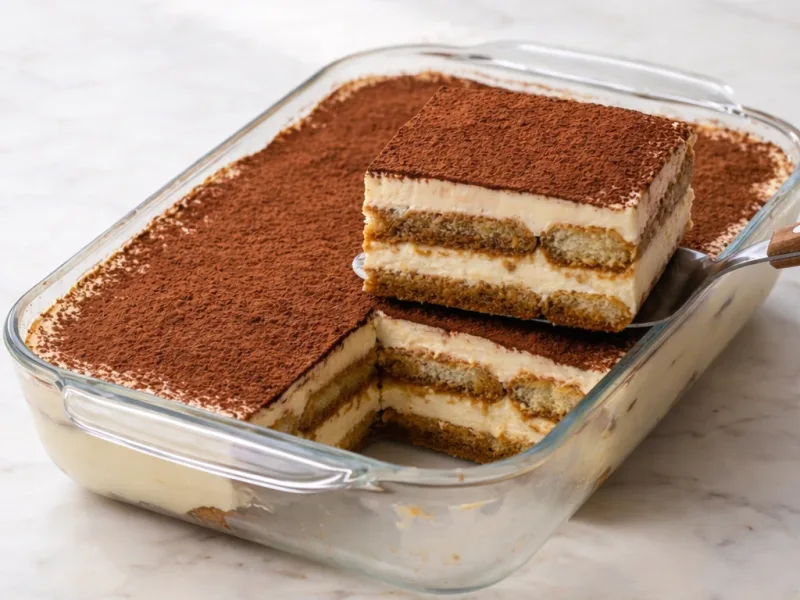
Base recipe: 1 rectangular tiramisu (20 × 30 cm)
Your kitchen companion
Ingredients
Check off ingredients as you prepare them.
Follow the steps at your own pace.
Method
Brew espresso: Prepare 1 2/3 cups (400 ml) strong espresso using a coffee machine or moka pot; cool to 68–72°F (20–22°C) to prevent cream destabilization.
Prepare pan: Select a 8 × 12 inch (20 × 30 cm) rectangular dish; ensure dry surface for proper layering.
Whip cream: Pour 1 2/3 cups (400 ml) heavy cream into a mixing bowl; whip with an electric mixer on medium speed until medium peaks form (holds shape but tip folds).
Mix mascarpone base: Combine 2 cups (500 g) mascarpone, 1/2 cup (120 g) sugar, 2 tsp (8 g) vanilla sugar, and 1/2 tsp (2 g) salt; mix until smooth with no lumps.
Fold cream: Fold whipped cream into mascarpone mixture using a spatula until fully combined and stable; stop when mixture is uniform and airy.
Dip biscuits: Dip each of the 24 savoiardi (300 g) into cooled espresso for 1 second per side; biscuits should be moist but not dripping.
Layer base: Arrange half of the dipped biscuits tightly in the dish to form the first layer; no gaps should remain.
Spread cream: Add half of the cream mixture evenly over biscuits using an offset spatula; surface should be level.
Repeat layering: Dip remaining biscuits and place as second layer; cover with remaining cream and smooth top evenly.
Dust cocoa: Sift 3 tbsp (20 g) cocoa powder evenly over surface; ensure dry, uniform coating.
Chill tiramisu: Refrigerate at 39°F (4°C) for at least 480 minutes; optimal structure forms at 480–720 minutes as fat solidifies and layers stabilize.
Extra technique, safety notes and details when you want to go deeper.
More tips & details
The Secret to Perfectly Defined Alcohol-Free Layers
Professional Stability for Every Homemade Slice
This gourmet preparation is built upon our Classic Italian Tiramisu foundation, refined here into a sophisticated, alcohol-free masterpiece. By substituting traditional raw eggs with a stabilized mascarpone and heavy cream blend, we create a dessert that holds firm, clean edges and a reliable internal structure. You will know your technique is successful when the layers remain sharply defined after chilling at 40°F (4°C) without any cream separation. This method is the gold standard for an easy tiramisu without alcohol, ensuring consistent, executive-level results in your home kitchen.
Mastering the Ideal Ladyfinger Hydration
A non-collapsing dessert depends entirely on how the biscuits interact with the bold espresso. Through a quick-dip technique, the ladyfingers absorb the coffee's essence, allowing moisture to migrate inward without reaching oversaturation. This creates a texture that is soft yet resilient, ensuring the base supports its own weight without liquid pooling at the bottom of your 8 x 12 inch (20 x 30 cm) pan. This balanced hydration makes it an excellent no alcohol tiramisu recipe for kids, where the depth of flavor relies on the aroma of premium coffee rather than spirits.
A Velvety Cream Base Without the Eggs
Our signature cream uses a fat-stabilized matrix of mascarpone and whipped cream to trap air, keeping the texture luxuriously light yet dense. This specific emulsion prevents the common frustration of layers "slumping" or losing their height during the setting phase. The cream is perfectly executed when it spreads with silky smoothness and maintains elegant peaks. Keeping your ingredients cold is paramount to prevent the fats from breaking. This technique delivers a simple homemade tiramisu no eggs can rival for both structural integrity and rich, gourmet flavor.
Chef’s Markers for the Perfect Finish
To ensure your creation meets my executive standards, verify these quality markers before your guests arrive:
- Layer Integrity: A distinct, visible contrast between the velvety cream and the dark, espresso-soaked ladyfingers.
- Cream Stability: A rich, stable body that provides clean resistance when sliced.
- Surface Aesthetics: A matte dusting of cocoa that stays dry, indicating the moisture has been properly absorbed.
- Flavor Profile: A harmonious balance of bitter espresso, dark cocoa, and sweet dairy.
This approach makes for the definitive beginner tiramisu recipe without alcohol, where ingredient purity provides a high-end sensory experience.
Professional Tips for Consistent Execution
As your Chef, I insist on using fully cooled espresso; warm liquid will immediately dissolve the cream’s structure, resulting in messy, blurred layers. When whipping the cream, aim for a medium peak to avoid a grainy mouthfeel, as over-whipping breaks the emulsion. Finally, assemble the dish efficiently—prolonged handling at room temperature will over-soften the biscuits and compromise the clean architectural lines of your final serving.
Optimal Chilling and Storage Guidelines
For the most exquisite flavor development, allow this tiramisu to rest in the refrigerator at 40°F (4°C). While the structure is stable early on, the peak texture is achieved between 8 and 12 hours, when moisture and fats reach a perfect equilibrium. You may store this dessert for up to 48 hours, provided it remains tightly covered to preserve the delicate dairy aromas and prevent the surface from drying.
Clean slices and defined layers at serving
The first cut reveals a tiramisu without alcohol prepared as a chilled, layered dessert without eggs, where structure depends on cream stability rather than custard. The surface holds a fine cocoa layer, and the interior shows clean, even layers with no visible collapse. Each slice lifts intact, with edges holding shape and no excess moisture at the base.
The texture settles into a balanced contrast: soft biscuit layers that yield gently, supported by a cream that remains smooth and lightly aerated. The mouthfeel is defined by stable cream density, not heaviness, allowing each component to remain distinct. The coffee note is present but controlled, without sharpness.
Balanced flavor for shared dessert settings
This format suits a table where portions are served directly from the dish, maintaining consistency across slices. The cocoa finish provides a dry surface that contrasts with the soft interior, while the espresso layer supports a steady, recognizable flavor profile. It fits naturally after a main course where a lighter, structured dessert is preferred.
Across servings, the composition remains uniform, with no variation between edge and center pieces. The interior retains its alignment, and the cream does not shift under light pressure. This ensures that each portion presents the same defined structure and smooth finish, suitable for both casual and more formal settings.
Questions
Why is tiramisu without alcohol too runny after chilling overnight?
Excess liquid from over-soaked ladyfingers or under-whipped cream causes structural breakdown and pooling at the base. When biscuits absorb too much espresso, they release moisture during chilling, weakening the mascarpone network. At the same time, insufficiently whipped cream lacks the fat structure needed to hold layers. The result is a loose, unstable dessert with blurred layers. Control dipping time and whip cream to stable medium peaks for proper consistency. Chef tip: Dip ladyfingers quickly—if they feel heavy in hand, they are already over-soaked.
Can I make tiramisu without alcohol without raw eggs and still keep it stable?
A stable structure is achieved by replacing eggs with whipped cream, which forms a fat-based network that holds air and supports layers. Without this, the cream lacks volume and collapses under its own weight. The key is balancing mascarpone density with properly whipped cream to maintain both firmness and lightness. This method produces clean slices and consistent texture without relying on egg-based emulsions.
Why do ladyfingers in tiramisu without alcohol become soggy or fall apart?
Excess espresso absorption breaks down the internal structure of ladyfingers, causing them to disintegrate and lose layering ability. These biscuits are highly porous and absorb liquid rapidly, especially when fully submerged. Once saturated, they cannot support the cream above. The correct state is moist on the surface while still firm inside, ensuring structural integrity and clean layers. Chef tip: Use room-temperature espresso; cold liquid slows absorption control and increases soaking time unpredictably.
How long should tiramisu without alcohol chill for clean slices and firm layers?
The structure sets when fat in mascarpone and cream solidifies and moisture redistributes evenly across layers. This process requires sufficient time at refrigeration temperature to stabilize the internal matrix. If cut too early, the cream remains soft and layers compress under pressure. A fully set tiramisu holds sharp edges and uniform layers when sliced, indicating proper stabilization.
Recivelle · /recipe/easy-homemade-tiramisu-recipe-without-alcohol