Base recipe: 4 servings
Your kitchen companion
Ingredients
Check off ingredients as you prepare them.
Follow the steps at your own pace.
Method
Dry the wings: Place 2.2 lb (1 kg) chicken wings in a large metal tray and pat thoroughly with paper towels until completely dry; the surface must feel dry to the touch or it will steam instead of crisp.
Season the wings: Transfer the wings to a large glass bowl and add 1¾ tsp (10 g) salt, 1 tsp (5 g) baking powder, ½ tsp (3 g) black pepper, and 1 tsp (5 g) garlic powder; toss evenly until all surfaces are lightly coated.
Arrange for airflow: Place the wings in a single layer inside a 5.5 L air fryer basket, leaving at least ½ inch (1 cm) space between each piece so hot air can circulate freely.
Preheat the air fryer: Set the air fryer to 392°F (200°C) and preheat for 3 minutes; this ensures immediate surface dehydration when cooking starts.
Cook first stage: Insert the basket and cook at 392°F (200°C) for 20 minutes; the skin should tighten and begin turning pale golden, not wet or soft.
Turn the wings: Open the air fryer and turn each wing using metal tongs to expose the underside for even heat distribution.
Finish cooking: Continue cooking at 392°F (200°C) for 10–15 minutes until the internal temperature reaches 180–185°F (82–85°C); the skin should be deep golden, blistered, and sound crisp when tapped with tongs.
Heat garlic butter: In a small saucepan over low heat (below 250°F / 120°C), melt 3 tbsp (40 g) butter and add 2 tsp (10 g) minced garlic; heat gently for 30 seconds until fragrant but not browned.
Coat the wings: Transfer hot wings into a large mixing bowl and immediately pour the garlic butter over them; toss quickly so the coating spreads thinly without soaking the skin.
Add cheese and herbs: Sprinkle ¼ cup (25 g) grated Parmesan cheese and 1 tbsp (5 g) parsley over the wings; toss again until evenly distributed and lightly adhered.
Rest before serving: Let the wings rest for 5 minutes on an open tray; this allows surface fat to stabilize and prevents steam from softening the crust.
Extra technique, safety notes and details when you want to go deeper.
More tips & details
Mastering dry-surface crisping for garlic Parmesan wings
Technical mechanism behind crisp skin formation
To get the Crispiest Air Fryer Garlic Parmesan Chicken Wings, the secret is surface dehydration paired with the precision airflow techniques found in our Air Fryer Meat Guide. Most beginners make the mistake of oiling the skin too early, which creates a localized steam barrier that leaves the wings rubbery rather than brittle. In my kitchen, I’ve found that if you don’t hear a sharp, dry hiss when the air hits the meat, you haven't dried them enough.
You should see the skin begin to contract and turn matte within the first 5 minutes at 400°F (204°C). If it looks shiny or wet, stop and pat it dry again. When the surface is right, the heat energy goes directly into browning the proteins instead of boiling off water, creating a crust that stays firm even after the sauce is added.
Structural behavior of fat and skin
As the timer hits the 15-minute mark, watch for tiny beads of fat bubbling up through the pores. This is the internal rendering phase, where subcutaneous fat pushes outward to essentially fry the skin from the inside. To get this right, you must leave a 1 cm (0.4 in) gap between pieces. If they touch, that fat pools and turns the skin into mush.
When you lift a wing with tongs, it should offer a brittle resistance rather than feeling heavy or limp. Proper spacing ensures the convection air whips around every edge, creating a consistent golden-brown finish. I always look for a slight blistering on the surface; it’s the physical sign that the moisture has successfully escaped.
Where most home cooks lose crispness
The biggest trap I see is treating wings like they are already sauced. If you look at Air Fryer Fried Chicken methods, the breading acts as a shield, but here, the skin is your only defense. Adding butter or oils too soon rehydrates the surface, turning your hard-earned crust into a soft, leathery layer.
Think of it as two separate phases: the build and the coat. The structure must be fully set before the garlic-butter emulsion ever touches the meat. This separation is what prevents the Parmesan from clumping into a greasy paste. By waiting, the cheese anchors to the hot fat on the surface, creating a distinct, textured finish that holds its snap.
Chef PEKIS recommendations
Stop relying solely on the buzzer and start using your senses. Give the basket a shake at the 20-minute mark and listen for a hollow clattering sound, which tells you the moisture is gone. Turn the wings exactly once to prevent tearing the delicate skin before it has fully hardened. If you apply the coating while the surface temperature is still above 165°F (74°C), the cheese bonds instantly to the rendered fat without drawing out internal juices.
Storage and stability considerations
Wings are a race against the clock because internal steam is always trying to move outward. Within 20 minutes of leaving the fryer, that steam will begin to soften the skin from the inside out. I’ve seen many home cooks ruin a batch by stacking them in a deep bowl where they sit in their own exhaust.
Instead, let them breathe on a wire rack for 60 seconds before serving. If you find they’ve lost their edge, a 3-minute blast at 380°F (193°C) will drive the moisture back out. This quick hit restores the shattering crunch and ensures the wings feel light and dry, just like they did when they first came out of the basket.
Structural state at the moment of serving
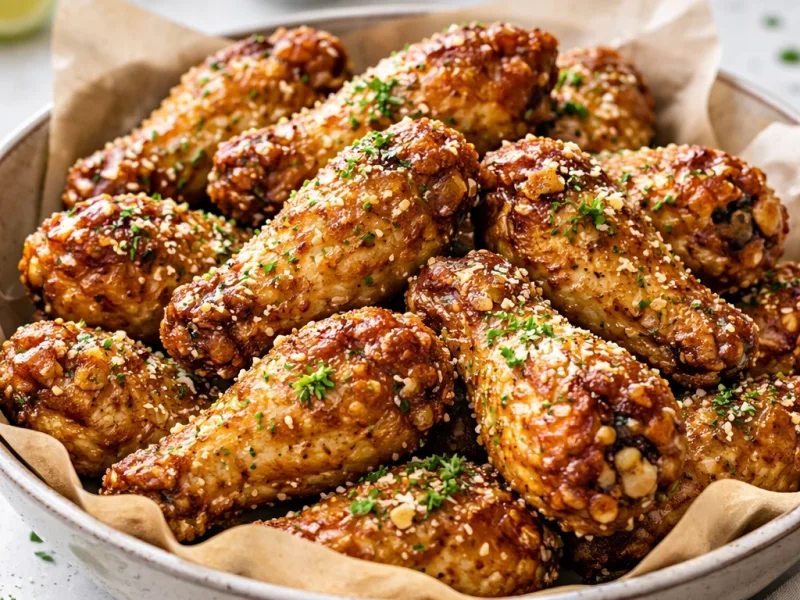
Crispiest Air Fryer Garlic Parmesan Chicken Wings are presented as a dry, fully rendered preparation with a rigid exterior and a thin, adherent coating that sits on the surface rather than soaking into it. The fat has stabilized just enough to create a light sheen without pooling, and the structure holds its shape when transferred to a serving bowl. At this stage, the skin remains taut, and the interior retains its moisture without releasing visible juices.
When bitten, the crust fractures with a short, dry crack, not a soft break. The resistance is immediate, followed by a quick collapse into a tender interior where rendered fat lubricates the meat fibers. Aroma is released only when the surface breaks, carrying garlic and aged cheese notes without heaviness. The coating does not slide; it clings. If the surface feels slick or bends before breaking, structural integrity has already begun to decline.
Timing, pairing, and environmental behavior
This preparation holds optimal texture for approximately 10–15 minutes in open air before residual moisture begins migrating outward. As internal vapor escapes, the crust gradually transitions from brittle to flexible. Keeping the wings uncovered slows this process by allowing steam to dissipate rather than condense. A closed environment accelerates softening, as trapped humidity rehydrates the surface layer.
The fat content requires balance. Sharp, acidic elements—such as a vinegar-based dip or fresh citrus on the side—reset the palate between bites and prevent saturation. In drier environments, the crust maintains stability longer, while in humid conditions it softens more rapidly, even without direct contact. As the dish cools, the coating tightens slightly and the aroma becomes more concentrated, though the crisp shell gradually loses its initial acoustic response.
Questions
Why are air fryer garlic Parmesan wings not crispy?
Surface moisture prevents crisping because water blocks Maillard browning and delays fat rendering. Drying the skin completely allows heat to drive evaporation first, then initiate crust formation. If wings are properly prepared, the skin tightens, blisters slightly, and sounds dry when tapped with tongs. If it looks pale and feels rubbery, moisture was not removed effectively.
Why do garlic Parmesan wings turn greasy after coating?
Excess butter softens the crust because it saturates the surface structure instead of forming a thin layer. The coating must bind to hot wings so fat spreads evenly without pooling. Properly finished wings show a light sheen and remain firm to the touch. If oil collects at the bottom of the bowl or skin feels slippery, too much fat was applied.
Why does garlic become bitter in air fryer chicken wings?
Garlic turns bitter when exposed to direct high heat due to rapid thermal degradation of its compounds. At high temperatures, sugars burn before aroma develops. Adding garlic after cooking preserves its volatile oils. Proper garlic appears pale golden and releases a clean aroma; if it turns dark brown and smells sharp, it has burned.
Why are air fryer chicken wings cooked unevenly?
Uneven cooking occurs when restricted airflow circulation creates hot and cool zones. Wings that touch trap steam, preventing consistent heat transfer. Proper spacing allows convection to surround each piece evenly. Finished wings should show uniform golden color and consistent crispness; if some areas are soft or pale, airflow was blocked.
Can garlic Parmesan wings be made without baking powder?
Wings can cook without it, but reduced alkalinity slows the browning reaction and weakens crust formation. Baking powder raises surface pH, accelerating crisp development. Without it, skin remains thinner and less rigid. Properly crisp wings display blistered skin and a firm texture; if the surface looks smooth and soft, browning was insufficient.
Recivelle · /recipe/crispiest-air-fryer-garlic-parmesan-chicken-wings