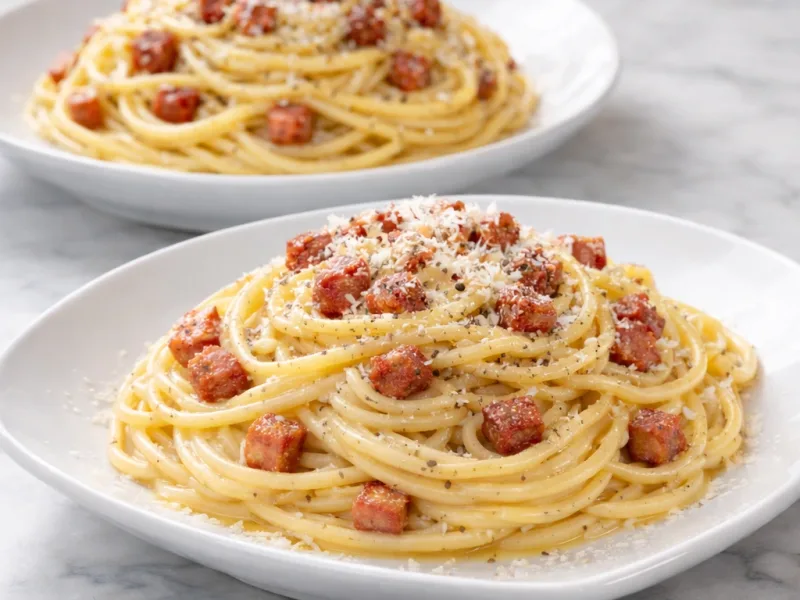
Base recipe: 2 servings (approximately 400 g cooked pasta dish)
Your kitchen companion
Ingredients
Check off ingredients as you prepare them.
Follow the steps at your own pace.
Method
Boil water: Fill a large pot with 2 quarts (2 liters) water and heat to 212°F (100°C); add 3 g salt and confirm full rolling boil with continuous surface movement.
Cook spaghetti: Add 7 oz (200 g) spaghetti and cook for 8–10 minutes until al dente; pasta should bend but retain a firm core when bitten; reserve 2 tbsp (30 ml) pasta water before draining.
Render guanciale: Place 2.8 oz (80 g) guanciale in a 10-inch (24–26 cm) sauté pan and heat on medium (320–338°F / 160–170°C surface temperature) for 5–6 minutes until fat is rendered and pieces are lightly crisp with golden edges; turn off heat.
Mix egg base: Combine 2 egg yolks, 1 whole egg, 1.4 oz (40 g) pecorino romano, and 2 g black pepper in a bowl; stir until a thick, cohesive paste forms with no dry cheese visible.
Coat pasta: Add drained spaghetti to the pan with guanciale and toss immediately so strands are evenly coated with rendered fat; pasta should appear glossy without pooling fat.
Create emulsion: Remove pan fully from heat (below 149°F / 65°C), add egg mixture, and gradually incorporate 2 tbsp (30 ml) pasta water while stirring continuously; sauce should become creamy and cling to pasta without forming curds.
Finish and serve: Adjust consistency by adding small amounts of remaining pasta water if needed; final texture should be smooth, glossy, and stable; serve immediately to preserve emulsion structure.
Extra technique, safety notes and details when you want to go deeper.
More tips & details
Creamy Carbonara Sauce Without Cream Forms by Controlled Heat
Achieving the Perfect Creamy Carbonara Sauce via Emulsion
The defining feature of authentic spaghetti carbonara is a glossy, tightly bound sauce created entirely without heavy cream. The emulsion forms when egg proteins thicken gently while binding with rendered pork fat and starchy pasta water. The mixture is successful when the pasta strands appear evenly coated with a smooth, velvety sheen and show no signs of liquid separation. This state is the hallmark of a true Roman carbonara, where the luxurious structure comes from controlled residual heat rather than added dairy.
Serving Temperature and Sauce Stability
This dish must be served immediately after emulsification while the sauce remains fluid yet stable. The correct serving state is observed when the coating clings to the spaghetti without sliding or pooling at the bottom of the plate. Because the sauce is an active emulsion, a delay of even a few minutes causes the sauce to "tighten" as residual heat continues to set the proteins. This results in a thicker, less elastic texture that loses its signature silkiness.
The Flavor Trinity: Guanciale, Pecorino, and Egg
The flavor profile depends on the synergy between cured pork, aged cheese, and eggs. For a standard yield of 7 oz (200 g) of pasta, the salt content is primarily derived from the 3 oz (80 g) of guanciale and 1.5 oz (40 g) of Pecorino Romano, requiring no additional salt at the finish. Freshly cracked black pepper provides the essential aromatic contrast, appearing as a sharp, warm note that cuts through the richness of the fats. Balance is achieved when the aroma remains clean and the pork fat carries the nutty notes of the aged cheese.
Starch and Fat Integration for Consistency
A critical technical factor is the presence of starchy gold—the dissolved starch from the boiling water. This starch acts as a stabilizer for the fat and egg mixture, preventing the proteins from curdling. The sauce is correctly formed when it clings uniformly to the pasta and does not appear greasy or broken. If the starch level in your 2.1 quarts (2 liters) of pasta water is insufficient, the fat remains unbound, resulting in a dull, oily surface rather than a cohesive, creamy coating.
The Importance of a Traditional Pasta Base
Final texture and sauce adhesion depend heavily on the pasta’s surface quality and starch release. While dried spaghetti is the standard for reliable results, fresh pasta introduces a softer structure. For those seeking a fully controlled experience, you may refer to our guide on homemade pasta dough for authentic Italian pasta, as the surface texture of the dough directly influences how the egg emulsion clings to each strand.
Chef PEKIS Professional Tips
Maintain low residual heat before introducing the egg mixture; temperatures exceeding 150°F (65°C) lead to rapid protein coagulation and visible curds. Continuous, vigorous movement during the emulsification phase ensures the Pecorino-egg paste distributes evenly. A uniform, glossy coating indicates correct thermal handling, while a matte or grainy appearance is a clear signal of temperature mismanagement or premature egg setting.
Storage and Immediate Consumption
This preparation is not suitable for storage or advance preparation. Because the emulsion is highly heat-sensitive, it will "break" upon reheating, leading to fat separation and a complete loss of the creamy texture. To experience the dish as intended, it must be consumed immediately to preserve its structural and aromatic integrity.
Best Served Immediately
Spaghetti carbonara without cream is a stovetop-finished pasta, not a baked dish, defined by a freshly formed sauce that remains fluid only at the moment of serving. The first contact with the plate reveals a silky coating that wraps each strand without slipping. The aroma is direct and focused—cured pork and aged cheese—without heaviness. When served at the right moment, the texture holds together with no visible separation and no excess moisture at the base.
The surface appearance signals readiness: a light sheen across the pasta and evenly distributed guanciale pieces. The dish should not appear dense or sticky; instead, it moves lightly when lifted. This is where the balance is most evident, with each element contributing without masking the others.
Balanced Texture for the Table
At the table, the structure remains stable for a short window, maintaining a glossy, cohesive finish that does not break when portioned. The strands separate cleanly, and the sauce remains attached rather than pooling. Each bite delivers a consistent texture, neither dry nor overly rich, with a clear savory profile.
This preparation fits naturally into a simple meal setting, where the focus stays on the plate itself. It pairs well with neutral sides that do not compete with its intensity. The experience is defined by contrast: tender pasta, lightly crisp guanciale, and a smooth, integrated sauce.
The final impression is controlled and precise, where texture and aroma remain aligned from first bite to last.
Questions
How do I make carbonara sauce creamy without using heavy cream?
Authentic creaminess is achieved through a stable emulsion of egg yolks, whole eggs, Pecorino Romano, and starchy pasta water. By keeping the pan temperature below 150°F (65°C) and stirring continuously, the egg proteins thicken into a velvety coating rather than scrambling. The 2 tablespoons (30 ml) of starchy water act as a binder, ensuring the sauce clings to the spaghetti with a glossy, professional sheen.
What is the best way to render guanciale for pasta?
For the best texture, start the 3 oz (80 g) of guanciale in a cold skillet and gradually increase to medium heat, approximately 320–340°F (160–170°C). This 5–6 minute process allows the pork fat to liquify completely while the exterior becomes lightly crisp. This rendered fat provides the essential flavor base and lipid component for the final sauce emulsion.
Can I reheat leftovers of authentic spaghetti carbonara?
No, this traditional preparation is not suitable for reheating as the egg-based emulsion is highly heat-sensitive. Reapplying heat will cause the proteins to over-coagulate and the fats to separate, destroying the glossy, creamy texture. For the best experience, the dish must be consumed immediately while the emulsion remains fluid and stable.
How do I prevent the cheese from clumping in the sauce?
Clumping is avoided by mixing the finely grated Pecorino Romano and eggs into a thick, uniform paste before it hits the pan. Removing the skillet completely from the heat source before adding this mixture ensures the cheese melts evenly into the fat and water emulsion rather than seizing due to excessive direct heat.
Why is my carbonara sauce watery or pooling at the bottom?
A watery sauce usually indicates an incomplete emulsion or an incorrect ratio of pasta water to fat. Ensure you are using exactly 2 tablespoons (30 ml) of starchy water and tossing the pasta vigorously to integrate the starch, fat, and eggs. The sauce is correctly formed when it uniformly coats every strand of spaghetti with no visible liquid separation.
Recivelle · /recipe/authentic-spaghetti-carbonara-recipe-italian-classic-made-simple