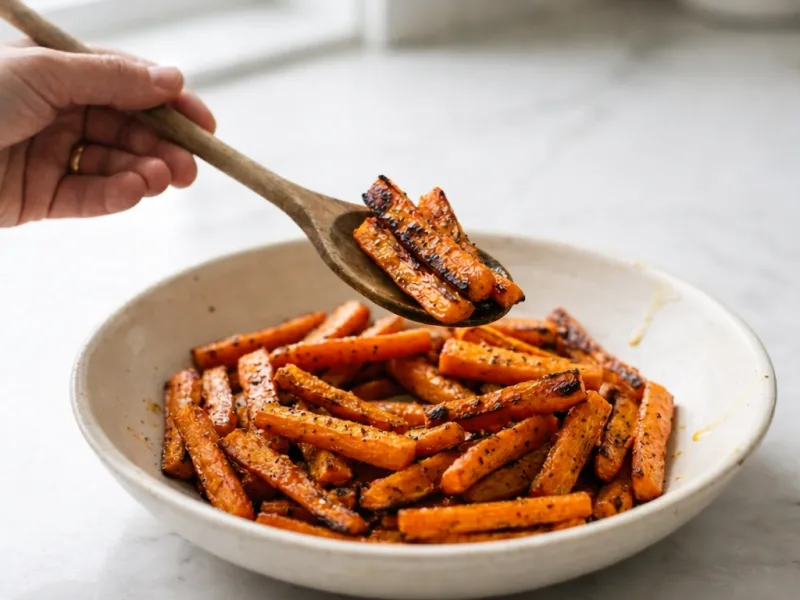
Base recipe: 4 servings (1.3 lb / 600 g finished carrots)
Your kitchen companion
Ingredients
Check off ingredients as you prepare them.
Follow the steps at your own pace.
Method
Preheat air fryer: Preheat air fryer (3.5–5 L basket) to 375°F (190°C) for 3 minutes to stabilize internal heat and airflow.
Prepare carrots: Peel 1.3 lb (600 g) carrots and cut into 1/2 inch (1 cm) thick, 2–3 inch (5–7 cm) sticks for even heat penetration.
Season carrots: Place carrots in a mixing bowl, add 1 tbsp + 1 tsp (20 ml) olive oil, 3/4 tsp (4 g) salt, 1/2 tsp (1.5 g) black pepper, 3/4 tsp (2 g) garlic powder, and 1 tsp (5 g) honey, then mix until evenly coated with a light, uniform layer.
Load basket: Transfer seasoned carrots into the air fryer basket in a single layer without overlap to maintain proper airflow and avoid steaming.
Cook initial stage: Cook at 375°F (190°C) for 12 minutes until carrots begin to soften; test by inserting a fork—there should be slight resistance in the center.
Redistribute carrots: Shake the basket thoroughly to reposition all pieces and expose new surfaces to direct circulating heat.
Finish cooking: Continue cooking at 383°F (195°C) for 6–8 minutes until edges are visibly browned and slightly crisp; check doneness by pressing a piece—the exterior should feel firm while the interior remains tender.
Rest before serving: Transfer carrots to a plate and rest for 3 minutes to allow moisture redistribution, preserving crisp edges and preventing surface softening.
Extra technique, safety notes and details when you want to go deeper.
More tips & details
Controlled Caramelization for Air Fryer Root Vegetables
Why this method delivers crispy edges and soft centers
This preparation refines the core principles of general air fryer vegetable techniques by focusing on dense root vegetables that require staged heat exposure. Air fryer carrots are often prone to uneven results when cooked at a single temperature, which can produce either dry interiors or insufficient browning. This variation addresses that limitation by separating internal softening from surface caramelization, allowing for precise control over both texture zones.
What makes this variation different from standard roasting
This method introduces a two-stage heat approach specifically adapted to the density and natural sugar composition of carrots. Unlike quick vegetable preparations, the initial phase prioritizes internal heat penetration at a moderate temperature, followed by a higher-temperature finish to develop crispy edges. The addition of a small amount of honey or sugar accelerates browning without requiring extended cooking time, significantly reducing the risk of dehydration. This approach is highly effective when aiming for crispy air fryer carrots without overcooking the core.
When to choose this method over quick air fryer vegetables
This preparation is ideal for situations where texture contrast is essential, such as serving alongside roasted proteins or structured main dishes. In contrast, faster options like crispy asparagus rely on low-density vegetables that cook evenly in a single stage. Carrots require additional time due to their compact cellular structure, making this method the preferred choice when a deeper roasted flavor and controlled softness are the primary goals.
How heat staging affects texture and flavor
Carrots contain natural sugars that begin to caramelize at elevated surface temperatures, but only after sufficient moisture has been released. The first stage softens the internal structure while preserving moisture to prevent collapse. The second stage increases airflow-driven dehydration, enabling caramelized edges to form without burning. This cause–effect relationship between staged heat and surface drying is critical for achieving a stable contrast between a tender interior and a lightly crisp exterior.
Chef PEKIS recommendations
Maintain a consistent cut size to ensure synchronized cooking, as uneven pieces will produce mixed textures. Avoid increasing the initial temperature, as premature browning prevents proper internal softening of the root. Use a brief resting period after cooking to stabilize the texture and prevent residual internal moisture from softening the crispy edges. Overloading the basket must be avoided, as it reduces airflow and leads to steaming instead of roasting.
Storage and make-ahead
This preparation is best served immediately while the surface remains dry and crisp. For short-term storage, keep the carrots refrigerated at 38–41°F (3–5°C) for up to 3 days. Reheat in the air fryer at 350°F (180°C) for 3–4 minutes to restore the intended surface crispness. Avoid covered reheating or using a microwave, as trapped moisture will soften the exterior and eliminate the texture contrast.
Crisp-edged vegetable side with balanced texture
Air fryer carrots are presented here as a structured side dish defined by a contrast between a lightly crisp exterior and a soft interior. The preparation focuses on maintaining shape while developing surface browning, resulting in evenly sized pieces that hold their structure on the plate. This format avoids mash-like softness and instead delivers a composed vegetable component suitable for plated meals.
The first bite reveals a thin, crisp surface that gives way to a moist interior with slight resistance. The natural sweetness becomes more pronounced as the exterior browns, while the interior remains smooth and stable. A light roasted aroma is noticeable immediately after serving, with subtle caramel notes. Pieces retain their form when handled, and the surface does not collapse or turn wet during serving.
Serving context and practical pairing use
This preparation works effectively as a warm side for roasted meats, grilled fish, or grain-based dishes where a defined vegetable texture is required. It can also be served as part of a composed plate alongside sauces or dips, as the caramelized edges provide enough structure to hold light coatings without softening. Portioning is straightforward, with each serving maintaining consistent texture across pieces.
In everyday meals, this dish fits well into structured lunches or dinner plates where balance between protein, starch, and vegetables is expected. It performs reliably in both individual plating and shared serving bowls, maintaining surface integrity during short holding periods. The texture remains stable when transferred from serving dish to plate, without sticking or breaking apart.
Questions
Why are air fryer carrots not crispy enough?
Insufficient airflow or low finishing temperature prevents surface dehydration and proper caramelization. When carrots are overcrowded, steam forms and softens the exterior instead of drying it. A higher final temperature is required to remove moisture and activate browning. Look for golden edges and slight resistance when pressed as a clear indicator of correct texture. Chef tip: Use a single layer with visible gaps for consistent airflow.
Why do air fryer carrots burn before softening inside?
Starting at too high temperature causes rapid sugar caramelization before internal heat penetration completes. Carrots are dense and require gradual heating to soften the core first. If edges darken too quickly while centers remain firm, the initial stage temperature is too high. Proper cooking shows evenly softened centers with controlled browning. Chef tip: Always begin at moderate heat before increasing temperature.
How do I cut air fryer carrots for even cooking?
Inconsistent size leads to uneven heat transfer and mixed texture results. Thicker pieces retain firmness while thinner ones overcook and dry out. Uniform sticks around 1/2 inch (1 cm) ensure synchronized cooking and stable structure. Visually, properly cut carrots cook evenly and show consistent browning across all pieces.
Can I make air fryer carrots without oil and keep texture?
Without oil, heat transfer is reduced and surface browning becomes uneven. Oil improves contact between hot air and the carrot surface, allowing controlled dehydration and caramelization. Oil-free versions tend to appear dull and dry rather than crisp. Properly cooked carrots should show slight sheen before cooking and dry crisp edges after.
Why are my air fryer carrots soft and watery?
Excess moisture retention from overcrowding or low heat prevents evaporation and leads to steaming instead of roasting. When carrots release water without sufficient airflow, the surface stays soft. Correct results show dry surfaces and light browning. If pieces appear pale and damp, airflow or temperature is insufficient.
Can I use frozen carrots in air fryer carrots recipe?
Frozen carrots release excess water during cooking, reducing caramelization and preventing crisp edges. The thawing phase introduces steam, which disrupts surface drying. For best results, fresh carrots are required to maintain structure and texture. Properly cooked carrots should show dry edges rather than a wet or glossy surface.
Recivelle · /recipe/air-fryer-carrots