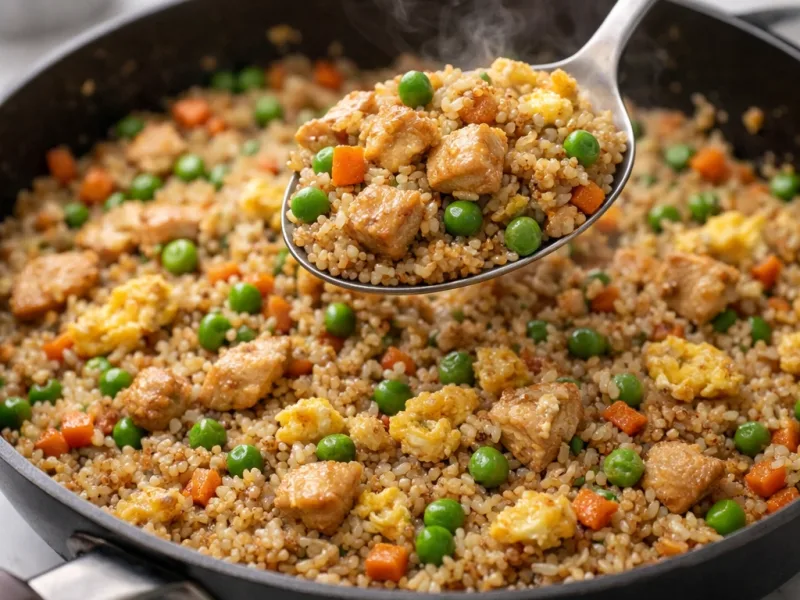
Base recipe: 4 servings
Your kitchen companion
Ingredients
Check off ingredients as you prepare them.
Follow the steps at your own pace.
Method
Preheat pan: Heat a 12-inch (30 cm) skillet or wok over high heat until hot, about 2 minutes; surface should feel very hot when holding a hand nearby.
Cook chicken: Add 1 tbsp (15 ml) oil and 10.5 oz (300 g) diced chicken; cook on high heat for 4–5 minutes until lightly browned and internal temperature reaches 165°F (74°C); remove and set aside.
Scramble eggs: Add remaining 1 tbsp (15 ml) oil and 2 large eggs (100 g); cook for 30–40 seconds over medium-high heat until just set with soft curds; remove and reserve.
Sauté garlic: Add 2 cloves garlic (6 g) to the hot pan; cook for 20–30 seconds over medium-high heat until fragrant but not browned.
Fry rice: Add 2 ½ cups cooked rice (400 g); stir-fry on high heat for 3–4 minutes, breaking up clumps until grains are separated and slightly dry to the touch.
Combine ingredients: Return cooked chicken and eggs to the pan with ¾ cup vegetables (100 g); stir briefly over high heat for 1–2 minutes until heated through.
Season rice: Add 3 tbsp soy sauce (45 ml), ½ tsp salt (3 g), and ¼ tsp black pepper (1 g); stir-fry for 2–3 minutes until evenly coated and lightly glossy; grains should remain separate.
Serve immediately: Remove from heat and serve hot; steam should be visible and rice should feel light, not sticky.
Extra technique, safety notes and details when you want to go deeper.
More tips & details
One-Pan Chicken Fried Rice as a Fast Home Standard
What Defines This 20-Minute Chicken Fried Rice Variation
Traditional chicken fried rice relies on high-heat stir-frying, using pre-cooked rice, diced protein, egg, and focused seasoning to ensure each grain remains distinct and lightly coated. This specific variation defines an efficient one-pan method engineered for consistent home results, significantly reducing preparation time while preserving the dish's essential structural integrity. It addresses the common challenges of multi-step cooking by consolidating every stage into a single vessel, maintaining high heat intensity and texture clarity throughout the process.
How This Version Solves Weeknight Cooking Constraints
This preparation is optimized for a strict 20-minute window, where precise ingredient sequencing replaces the need for complex prep work. By introducing the rice while it is still chilled, the method encourages immediate evaporation rather than steaming, keeping the grains dry and separate. The result is a reliable weeknight solution where timing is fixed and the final texture remains stable even after a short holding period of 3 to 5 minutes.
The Stir-Fry Technique and Rice Behavior
The primary mechanism at work is high-temperature stir-frying, allowing for rapid heat transfer across the pan’s surface. At approximately 392°F (200°C), residual moisture in the rice evaporates instantly upon contact, preventing clumping and creating a light surface sheen instead of wetness. Achieving this requires a correctly prepared base; for consistent results, ensure you know how to cook fluffy rice every time. This technical foundation determines whether the final product is airy and lightly crisped or dense and compressed.
Structure and Flavor Balance in a Simple Fried Rice Recipe
This version utilizes a focused ingredient set to maintain a precise balance between bulk and flavor:
- Rice dominance: Establishes the textural foundation and volume.
- Protein distribution: Small chicken pieces ensure rapid cooking and even flavor absorption.
- Egg integration: Adds richness without binding the grains too tightly.
- Minimal seasoning: Soy sauce provides salt and umami without overwhelming the base.
The outcome is a clean, savory profile where every component remains identifiable. While this version focuses on speed, those seeking a deeper regional profile can explore our authentic Thai fried rice, which utilizes traditional aromatics for a distinct umami finish.
Chef PEKIS Recommendations
Always use a fully preheated pan before adding any ingredients; insufficient heat leads to moisture retention and a soft, undesirable texture. Add the rice only when the surface is visibly hot to trigger immediate evaporation. Avoid stirring continuously during the first minute after adding the rice, as this allows for proper contact with the pan to encourage light browning. Furthermore, overcrowding the pan will drop the temperature, causing the ingredients to steam rather than fry.
Serving Characteristics and Final Texture
The finished dish should feature separate grains with light golden edges, evenly distributed chicken, and small, irregular egg curds. Visible steam at the moment of serving indicates high internal heat. The texture should remain stable for several minutes after plating, with no signs of pooling liquid or surface stickiness on the rice.
Storage and Make-Ahead Suitability
This preparation is at its peak immediately after cooking when the grain separation is most prominent. It can be stored refrigerated at ≤40°F (4°C) for up to 3 days, though the texture will naturally compact as starch retrogradation occurs. Reheating is most effective in a hot pan to restore surface dryness; relying solely on a microwave often leads to moisture buildup and a loss of the original structure.
Serving context and defining format
Chicken fried rice is presented as a complete one-pan meal, where rice, protein, and vegetables are combined into a single, cohesive preparation. This version follows a simplified structure with a reduced ingredient set, focusing on clarity of texture and direct flavor expression rather than layered seasoning. The format is compact and self-contained, typically served immediately after cooking in a bowl or shallow plate, where the mixture holds its shape without spreading or releasing excess moisture.
Sensory profile and eating experience
The first impression is defined by separated grains that move freely with each spoonful, without sticking or compressing. Lightly browned surfaces introduce a subtle firmness, while small egg curds provide softness and contrast. The aroma is clean and savory, with noticeable garlic notes that dissipate quickly after serving. Chicken pieces remain tender and slightly springy, creating a balanced bite where no component dominates or feels dense.
Meal timing and pairing use
This preparation is commonly used as a standalone meal, particularly suited for lunch or early evening service where a balanced portion is required without additional courses. It pairs naturally with simple sides such as steamed vegetables or light broths, which complement the dry surface texture without adding heaviness. When portioned correctly, one serving remains stable during eating and does not compact or lose structure over time.
Consistency and serving reliability
The mixture maintains its integrity for several minutes after plating, with no visible liquid separation or surface gloss increase. Each spoonful retains consistent distribution of ingredients, ensuring even texture throughout. This stability allows for controlled serving in both individual portions and shared dishes, without requiring immediate consumption to preserve quality.
Questions
Why is my chicken fried rice soggy instead of dry?
Excess moisture and low heat cause soggy texture; increase heat and use cold rice. When rice is added warm, surface starch retains water and prevents evaporation. Proper high heat allows moisture to escape quickly, creating a dry, separated structure. If steam builds instead of sizzling, the pan is overloaded or not hot enough; grains will appear glossy and clump together.
Why does chicken fried rice stick to the pan?
Insufficient oil or low preheat causes sticking; heat pan fully and coat with oil. A cold pan prevents proper oil film formation, leading to direct starch contact and adhesion. When correctly heated, oil creates a barrier that allows rice to move freely. If rice drags or tears, surface temperature is too low; grains should slide and separate easily.
Why are my rice grains clumping together in fried rice?
Fresh rice and excess starch cause clumping; use chilled, dry rice instead. Newly cooked rice contains surface starch that binds grains during frying. Cooling reduces moisture and stabilizes structure. Proper grain separation occurs when rice feels slightly dry before entering the pan. If grains stick in clusters, they were not cooled long enough or were overmixed.
Why is chicken dry in chicken fried rice?
Overcooking at high heat dries chicken; cook briefly and remove early. Small pieces cook quickly and lose moisture if left too long. Proper protein handling requires short exposure to high heat, followed by removal to prevent carryover drying. Chicken should remain tender with slight browning; if fibers appear stringy, it has exceeded optimal cooking time.
Can chicken fried rice be made without soy sauce?
Lack of soy sauce reduces umami; replace with salt and broth-based seasoning. Soy sauce provides both salt and depth through umami compounds. Without it, the dish can taste flat unless compensated with layered seasoning. A balanced alternative maintains salt level and slight color development. If rice appears pale and lacks aroma, seasoning depth is insufficient.
Why does chicken fried rice taste bland even with seasoning?
Uneven distribution of seasoning causes blandness; mix at high heat for full coating. If seasoning is added too early or at low heat, it absorbs unevenly into rice. Proper flavor distribution occurs when sauce contacts hot grains and spreads quickly. Each grain should show light color coating; if patches remain pale, mixing and heat level were insufficient.
Recivelle · /recipe/20-minute-one-pan-chicken-fried-rice-easy-takeout-style