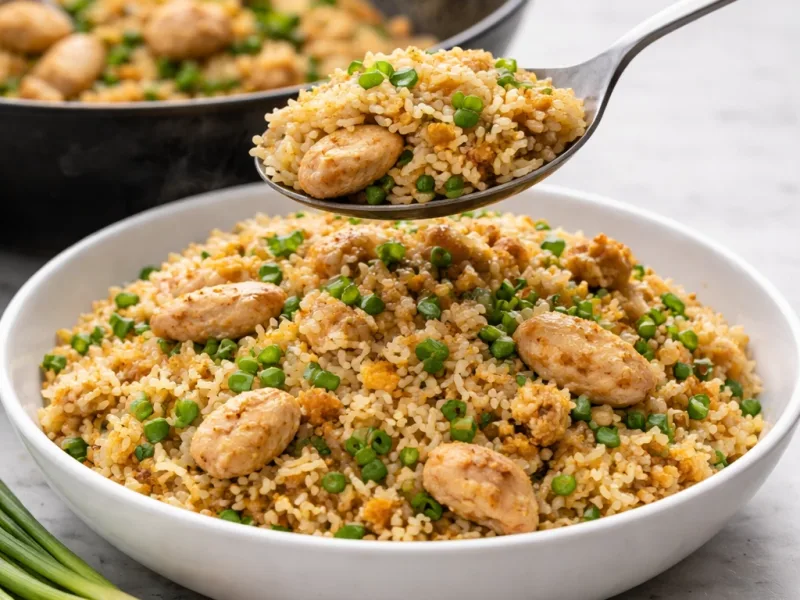
Base recipe: 2 servings
Your kitchen companion
Ingredients
Check off ingredients as you prepare them.
Follow the steps at your own pace.
Method
Heat the pan: Place a 28–30 cm wok or wide frying pan over high heat (400–425°F / 200–220°C) and preheat for 1 minute until a drop of water evaporates instantly.
Cook the chicken: Add 1.5 tbsp (20 ml) oil and immediately add 5.3 oz (150 g) diced chicken; stir-fry for 2–3 minutes until lightly browned and no pink remains in the center.
Add aromatics: Add 2 cloves (10 g) minced garlic and ½ cup (60 g) chopped onion; stir-fry for 30–45 seconds until fragrant but not browned.
Scramble the eggs: Push ingredients to one side and crack in 2 eggs (100 g); scramble for 30–40 seconds until softly set but still slightly moist.
Add the rice: Add 2 cups (300 g) cold cooked jasmine rice; break apart clumps with a spatula and mix evenly for 1–2 minutes until grains are separated.
Season the rice: Add 1 tbsp (15 ml) fish sauce, 2 tsp (10 ml) soy sauce, 1 tsp (5 g) sugar, and ¼ tsp (1 g) white pepper; stir-fry for 2–3 minutes until the rice looks dry and evenly coated.
Finish with green onions: Add ⅓ cup (40 g) sliced green onions and toss for 15–20 seconds until slightly softened.
Serve immediately: Transfer to a plate and serve hot with lime wedges and ⅓ cup (50 g) cucumber slices; squeeze lime just before eating for acidity.
Extra technique, safety notes and details when you want to go deeper.
More tips & details
Fast wok-fried rice with separated grains and balanced flavor
Structure and purpose of this 15-minute Thai street preparation
This recipe establishes a streamlined approach to Khao Pad (Thai Fried Rice), engineered for consistent, professional results within a strict 15-minute timeframe. It adheres to the classic framework of stir-fried jasmine rice, eggs, and protein, while prioritizing a dry texture and distinct flavor separation. The technique addresses the common home-cooking pitfall of mushy or over-seasoned rice by implementing rigorous heat management and restricted liquid integration.
The quality of fried rice depends directly on properly cooked and cooled grains. Using correctly prepared rice ensures separation, preventing clumping during stir-frying, as detailed in how to cook rice fluffy every time. This method maintains that foundational principle to achieve a light, non-greasy finish.
How this method differs from traditional rice dishes
This version utilizes high-heat stir-frying rather than slow-cooking or steaming, facilitating rapid moisture evaporation and immediate service. Unlike layered rice dishes that develop complex flavors over hours, this method builds savory depth through direct thermal contact and rapid seasoning absorption.
Rice-based dishes vary significantly in preparation, from fast stir-frying to slow, layered cooking methods. For instance, an one-pot chicken biryani relies on gradual steaming and spice infusion, resulting in a denser, highly aromatic structure. In contrast, this Thai preparation produces a dry, distinct grain texture with immediate flavor clarity.
Technical behavior of high-heat stir-frying (how to make Thai fried rice at home)
The defining mechanism is rapid heat transfer at temperatures exceeding 400°F (200°C), where moisture evaporates faster than it can accumulate. This prevents the rice from steaming, allowing the grains to remain loose and separate while absorbing seasoning evenly.
This dish shares the same fast wok technique used in other Thai street classics, with rice replacing noodles, as seen in authentic pad thai with chicken. Unlike noodle-based dishes, this version uses rice to absorb savory sauces while maintaining a lighter, airier structure. The result is a lightly caramelized surface with subtle wok hei, the characteristic smoky aroma formed during rapid oil vaporization.
Reliability and repeatable results in a 15-minute workflow
This workflow is engineered for repeatability under standard kitchen conditions. The compressed cooking window requires strict ingredient sequencing: protein first for proper browning, aromatics second to release essential oils, and rice last to maintain precise moisture control.
Key outcomes of this technical structure:
- Grain separation stability: dry, non-sticky rice after 2–3 minutes of stir-frying
- Controlled moisture release: no visible steam accumulation in the final stage
- Balanced seasoning absorption: uniform coating without pooling liquids
These parameters ensure the dish maintains a consistent texture and balanced flavor profile across every execution.
Chef PEKIS recommendations
Maintain maximum heat from the moment the rice enters the pan; any drop in temperature causes steaming instead of frying, resulting in soft, clumped grains. Utilize a wide cooking surface to prevent overcrowding, as restricted space traps moisture and inhibits caramelization.
Apply seasoning in small, controlled quantities and distribute it immediately. Excess liquid delays evaporation and prevents the formation of a dry surface, which is essential for achieving the correct street-style texture.
Storage and make-ahead limitations
This preparation is best enjoyed immediately after cooking while the rice remains dry and separated. Once cooled, starch retrogradation causes the grains to firm and lose their characteristic light texture.
If storage is necessary, refrigerate at 40°F (4°C) or lower and consume within 24 hours. Reheating should be performed in a hot pan to restore partial dryness; however, the original texture cannot be fully recovered due to structural changes in the rice starch.
Clean, fast-served rice dish with distinct grain structure
Authentic Thai Fried Rice (Khao Pad) is served immediately after cooking as a dry, stir-fried rice dish with clearly separated grains and integrated protein. It is defined by a non-saucy format where seasoning is absorbed rather than pooled, creating a light and structured plate. This preparation avoids excess moisture, resulting in a dry surface finish that distinguishes it from softer rice dishes.
The first impression is a lightly aromatic profile with subtle savory depth and mild sharpness from fresh elements. Each bite maintains separated grains that move freely without clumping, while small egg curds provide softness against the firmer rice. The aroma remains clean and slightly toasted, and the absence of heavy coating allows individual components to remain identifiable during eating.
Practical serving use and pairing context
This dish fits as a standalone main meal or as part of a shared table with simple accompaniments such as fresh vegetables or light soups. It is commonly served as a quick lunch or evening meal where minimal plating is required. The structure allows it to hold briefly without collapsing, but it is best consumed while the grains retain their lightly firm texture and do not absorb ambient moisture.
In a social setting, it integrates easily with other dishes due to its neutral yet balanced flavor profile. The portion can be adjusted without affecting structure, making it suitable for both individual serving and shared dining. Its consistency remains stable during short holding periods, provided it is not covered, which would otherwise trap steam and soften the grains.
Questions
Why does Thai fried rice turn out soggy?
Excess moisture from warm rice or overcrowding causes steaming instead of frying. Proper stir-frying requires dry, cooled grains so surface moisture evaporates quickly under high heat. When moisture remains trapped, rice becomes soft and sticky rather than separated. Visible steam and glossy texture indicate incorrect heat or excess liquid during cooking.
Why does Thai fried rice stick together instead of separating?
Sticky texture results from high starch content and insufficient cooling before frying. Freshly cooked rice retains surface starch and moisture, causing grains to bind during heat exposure. Using cooled rice reduces surface stickiness and allows proper separation. If grains clump when stirred, the rice was not adequately cooled or dried.
Why does Thai fried rice lack smoky flavor?
Low heat prevents formation of Wok Hei, the smoky aroma from rapid oil vaporization. Without sufficient temperature, ingredients release moisture instead of caramelizing. Proper heat creates light browning and subtle smokiness. If no toasted aroma is present, the pan temperature is too low or overloaded.
Why does Thai fried rice taste bland even with seasoning?
Improper seasoning distribution or low heat prevents flavor absorption. When heat is insufficient, sauces remain on the surface instead of binding to rice. Proper stir-frying ensures even coating and slight caramelization. If rice appears pale and lacks aroma, seasoning was not integrated at high temperature.
Can Thai fried rice be made without fish sauce?
Flavor depth decreases without fish sauce, requiring alternative umami sources. Fish sauce provides salt intensity and fermented complexity that defines the dish. Substitutes like soy-based sauces lack the same depth, resulting in a flatter profile. If aroma lacks sharp savory notes, umami balance is incomplete. Chef tip: Add a small amount of fermented soy or mushroom sauce to partially restore depth.
Why does chicken in Thai fried rice become dry?
Overcooking at high heat removes moisture from lean protein quickly. Chicken should be cooked just until no longer pink to retain internal moisture. Extended cooking causes firm, dry texture and reduced flavor absorption. If chicken feels tough and fibrous, it remained in the pan too long before rice was added.
Recivelle · /recipe/thai-fried-rice-khao-pad-easy-delicious