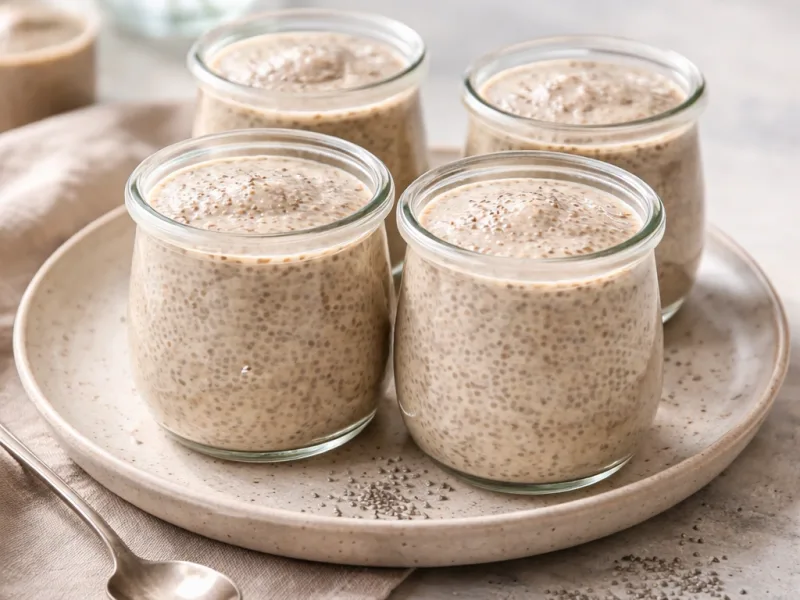
Base recipe: 4 jars of chia pudding (total about 21 oz / 600 g)
Your kitchen companion
Ingredients
Check off ingredients as you prepare them.
Follow the steps at your own pace.
Method
Dissolve the liquid base: In a mixing bowl, combine unsweetened almond milk (2 US cups / 480 ml), powdered erythritol (24 g / about 2 US tablespoons), vanilla extract (3/4 US teaspoon / 4 ml), and fine sea salt (1 g / about 1/4 US teaspoon). Whisk until the sweetener is fully dissolved and the liquid appears smooth and uniform.
Incorporate the chia seeds: Add chia seeds (80 g / about 1/2 US cup) to the bowl. Whisk thoroughly for about 20 seconds, making sure the seeds are evenly distributed with no dry clumps sticking to the sides or bottom.
Begin hydration: Let the mixture stand at room temperature for Resting time: 10 minutes. This allows the seeds to start absorbing liquid and prevents settling. Whisk again until the mixture looks evenly speckled and slightly thicker.
Portion into jars: Divide the mixture evenly among 4 clean glass jars, each holding about 3/4 cup (200 ml). The surface should be level and fluid but show light resistance when the jar is tilted.
Cold set the pudding: Cover the jars and place them in a refrigerator set to 4 °C (39 °F). Chill for Chilling time: 4 hours. During this period, the chia seeds fully hydrate and form a stable gel structure.
Stabilize before serving: Keep the jars refrigerated for an additional Chilling time: 30 minutes. The pudding should be thick, creamy, and spoonable, holding clean lines when stirred. If the texture appears loose, chill for 30 minutes longer.
Extra technique, safety notes and details when you want to go deeper.
More tips & details
Designed for reliable no-cook desserts and calm daily routines
The pudding sets into a creamy vegan dessert with clean structure
This preparation produces a chilled, spoonable pudding built for cooks who want consistency without heat or timing pressure. The structure depends on controlled hydration rather than cooking, which removes common beginner errors tied to temperature and timing. When finished correctly, the surface is level, the body is cohesive, and the spoon moves through with light resistance. This behavior is what many cooks expect when searching for a creamy vegan chia pudding that can be prepared once and served calmly later.
The structure stabilizes during chilling and stays uniform
The defining mechanism is moisture absorption: chia seeds bind liquid and form a gel matrix that thickens gradually. This process continues even after the mixture appears set, which is why uninterrupted chilling matters. You’ll know it is progressing correctly when the pudding holds a straight edge after stirring and shows no dense layer at the bottom. This stable setting window makes the dish suitable as a make-ahead vegan dessert without last-minute adjustments.
The flavor profile stays clean and balanced when fully cold
Serving temperature directly affects perception. When fully chilled, vanilla reads clearly and sweetness stays precise rather than heavy. A short rest after complete setting allows aromas to settle and prevents any raw seed notes. Served cold, the pudding keeps its shape on the plate and presents as a finished dessert rather than a loose breakfast mixture.
The dish fits naturally into light meals and no-cook menus
Because the flavor is restrained and the texture is clean, the pudding integrates easily into light menus. It works after savory dishes and also fits into plant-based meal plans focused on minimal preparation. Cooks familiar with hydration-based breakfasts will recognize the same logic in Peanut Butter Banana Overnight Oats, where structure is created through resting rather than heat. Understanding this overlap helps build confidence across similar no-cook preparations.
Texture contrast becomes clearer with dry or crisp elements
The pudding’s smooth body becomes more defined when paired with something crisp. Serving it alongside Easy Homemade Granola highlights the contrast without altering the base recipe. This approach keeps the pudding intact while offering a clear textural reference that many diners expect in a plated dessert.
Cold-set desserts benefit from clear serving context
Chilled, spoonable desserts share practical similarities even when ingredients differ. A fruit-based option like Tropical Acai Bowl with Berries and Granola illustrates how temperature and density affect serving behavior in cold preparations. Seeing these patterns helps cooks plan menus where multiple cold desserts can be prepared and stored with confidence.
Chef PEKIS recommends
Allow a short rest before chilling so the seeds distribute evenly; skipping this leads to compact layers and uneven texture. Keep containers fully covered during refrigeration, as surface exposure dries the top and weakens the gel. Once set, avoid stirring again, because breaking the structure reduces the clean, spoonable finish.
Storage and make-ahead
This dish is well suited to advance preparation. Store covered in the refrigerator at 4 °C (39 °F) for up to 3 days. The structure remains stable within this window, but longer storage gradually firms the gel and softens the intended creamy texture.
Served Cold at the Table
The first spoonful establishes what this dish is: a chilled preparation built on hydration rather than cooking, finished in individual jars instead of being baked or set with heat. Sugar-Free Chia Pudding Creamy Vegan Dessert arrives with a surface that holds its line and a body that yields cleanly, offering a smooth, cohesive texture without looseness. The seeds are present but integrated, giving gentle resistance rather than crunch. This balance makes the pudding feel deliberate on the plate, not improvised, and keeps each bite consistent from edge to center.
As it’s eaten, the flavor stays restrained and even. There is no sweetness spike, no trailing bitterness, and no grainy finish. Vanilla reads softly, and the base carries a neutral tone that lets the texture remain the focus. The mouthfeel stays stable across the serving, which matters when the dish is shared slowly rather than rushed. Nothing shifts or collapses as the jar empties, so the last spoon matches the first.
Quiet Finish for Light Meals
This pudding fits naturally at the end of a light meal, where richness would feel out of place. It works just as well after vegetables and grains as it does following a simple lunch. Because the structure holds, it can be plated or eaten straight from the jar without changing how it feels. The experience stays calm and contained, with no melting or pooling to distract from the texture.
There is also ease in how it’s shared. Jars can be passed around the table without explanation, and the portion feels complete on its own. The surface remains intact, the body stays evenly set, and the flavor doesn’t fade as it warms slightly in the room. That reliability gives confidence when serving guests or packing a dessert ahead of time.
In quieter moments, it suits solitary eating just as well. The spoon moves steadily, the texture stays predictable, and the finish is clean. There’s no need to adjust, mix, or correct anything mid-serving. The dish simply holds its place until the jar is empty, leaving a clear sense of closure rather than heaviness.
Questions
Is this chia pudding suitable for a keto-style diet?
Low net carbohydrates depend on sweetener choice and portion control. Erythritol contributes sweetness without digestible sugars, which keeps the glycemic impact low. Chia seeds provide fat and fiber that slow digestion, supporting ketosis-friendly macros. Texture remains unchanged under keto use because gel formation depends on hydration, not sugar. Practically, many low-carb cooks use this as a controlled dessert jar when tracking daily intake.
Why does my chia pudding sometimes turn lumpy or uneven?
Uneven texture comes from incomplete seed dispersion during early hydration. Chia seeds begin absorbing liquid immediately, and dry clusters lock in before they can spread. Technically, this creates dense gel pockets that never fully smooth, even after chilling. A second whisk after a short rest breaks these early bonds. In practice, a smooth surface before refrigeration predicts a uniform set later.
Can almond milk brands affect the final thickness?
Thickness varies with protein and stabilizer content in commercial almond milks. Some U.S. brands include gums that slightly thicken liquids, reinforcing the gel. Technically, chia absorbs free water, not bound moisture, so thicker milks can yield a firmer set. Practically, unsweetened cartons labeled “barista” or “extra creamy” often produce a denser spoon feel.
Why does the pudding taste flatter when eaten immediately after mixing?
Flavor perception changes as temperature drops and hydration completes. Warm mixtures mute vanilla aroma and exaggerate seed notes. Technically, chilling slows volatile release while allowing sweetness to balance. After full refrigeration, the aroma stabilizes and the gel smooths. Practically, the pudding tastes cleaner and more rounded after it is fully cold-set.
Is it normal for the surface to firm more than the center?
Surface firmness usually reflects airflow and temperature gradients in home refrigerators. Cold air hits the jar walls first, setting the outer layer faster. Technically, this is normal gel behavior. Keeping jars covered reduces moisture loss and evens setting. Practically, a short stabilization rest resolves most surface firmness without stirring.
Recivelle · /recipe/sugar-free-chia-pudding-delicious-dessert-healthy-eating