Base recipe: 12 mooncakes
Your kitchen companion
Ingredients
Check off ingredients as you prepare them.
Follow the steps at your own pace.
Method
Mix liquid base: Combine ½ cup + 2 tbsp (140 g) golden syrup, 3 tbsp + 1 tsp (50 g) vegetable oil, 1 tsp (4 g) alkaline water, and ¼ tsp (1 g) salt in a mixing bowl until smooth and uniform.
Form dough: Add 1 ¼ cups (200 g) all-purpose flour and mix until a soft dough forms with no dry patches; the dough should feel pliable but not sticky.
Rest dough: Cover the dough and rest for 60 minutes at room temperature to allow hydration and gluten relaxation, improving elasticity and shaping.
Portion filling: Divide 10 ½ oz (300 g) lotus seed paste into 12 portions (0.9 oz / 25 g each) and roll into smooth balls; surfaces should be uniform with no cracks.
Portion dough: Divide rested dough into 12 portions (1 oz / 30 g each) and flatten each into a disc approximately 3 inches (7–8 cm) wide.
Enclose filling: Wrap each lotus paste portion with one dough disc, sealing completely; roll gently into a smooth sphere with no visible seams.
Shape mooncakes: Lightly dust a 75 g mooncake mold and press each filled ball firmly into the mold, then release onto a flat baking tray; patterns should remain intact.
Initial bake: Place tray on the middle rack and bake at 356°F (180°C), conventional oven, for 10 minutes; surfaces should turn slightly matte but not brown.
Apply egg wash: Remove from oven and brush each piece lightly with a mixture of 1 egg yolk (20 g) and 2 tsp (10 ml) water; apply thinly to avoid pooling.
Final bake: Return to oven at 356°F (180°C), middle rack, and bake for 10–12 minutes until evenly golden brown; edges should show slight browning variation.
Cool: Transfer to a rack and cool for 120–180 minutes until fully set; this stabilizes structure and prevents surface collapse.
Rest and mature: Store at room temperature for 24–48 hours before serving; this allows oil redistribution, softening the crust and improving texture cohesion.
Extra technique, safety notes and details when you want to go deeper.
More tips & details
Structure, texture, and festival readiness of traditional lotus mooncakes
Dense filling holds shape and defines the bite
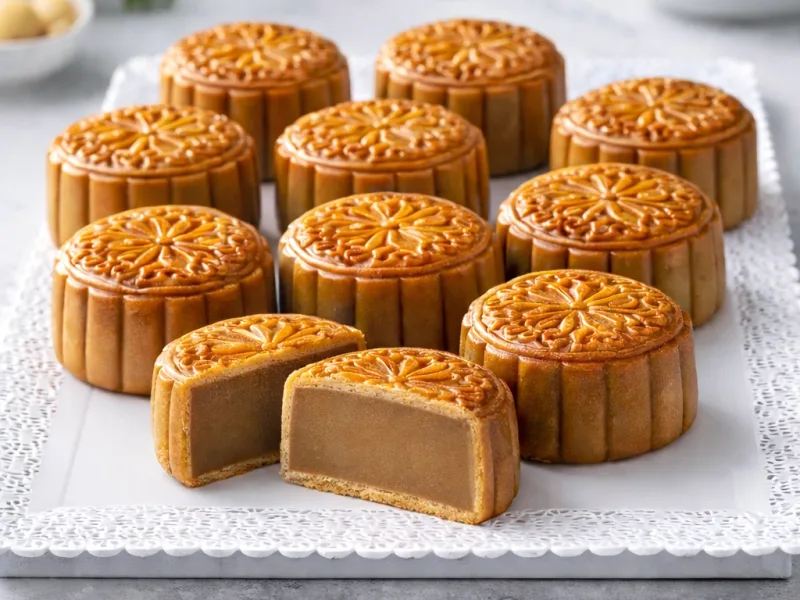
Traditional mooncakes present a compact structure where the lotus paste remains smooth and stable when cut, without crumbling or leaking. The pastry layer forms a thin, cohesive shell that follows the contour of the filling. The result is on track when the interior appears uniform and slightly matte, indicating proper moisture balance rather than excess oil separation. This preparation aligns with what cooks expect when searching for a traditional lotus paste mooncakes recipe.
Balanced sweetness supports prolonged serving
The sweetness is concentrated yet controlled, allowing the pastry to be served in small portions without palate fatigue. The outer layer contributes mild caramel notes, while the filling provides depth and continuity. This balance becomes evident when the first bite transitions cleanly from crust to filling without sharp contrast. At room temperature, the aroma remains stable and does not intensify excessively, which is essential for extended table presentation.
Festive serving context ensures portion clarity
These pastries are designed for shared occasions, where each piece functions as an individual serving. They perform best when presented whole and cut only when needed, preserving surface integrity. The texture remains consistent within a serving window of several hours, making them suitable for gatherings where timing varies. A similar role in dessert structure can be observed in Traditional Spanish Flan: Creamy Caramel Custard, where portion clarity defines service.
Controlled baking creates stable exterior patterns
The patterned surface remains visible after baking, with slight softening that indicates correct heat exposure. Excessive gloss or overly sharp edges would signal imbalance in surface treatment. The crust should feel firm but not rigid, with minimal resistance when cut. This outcome reflects proper heat distribution, where the outer layer sets without drying the interior.
Flavor continuity supports variation without loss of identity
The preparation allows adaptation through filling adjustments while maintaining structural integrity. Variants such as those inspired by Lotus Cheesecake Recipe demonstrate how lotus-based flavor profiles can extend into different textures while preserving core taste identity. In this pastry, the flavor remains stable across resting time, with no separation between crust and filling.
Chef PEKIS recommends
Allow sufficient resting time after baking so the crust absorbs internal oils, which results in a softer bite. Avoid excessive egg wash, as this creates uneven surface coloration and masks the natural pattern. Maintain consistent portion sizing; irregular weight distribution leads to uneven baking and visible distortion. A properly rested batch will show improved cohesion and reduced surface dryness.
Storage and make-ahead conditions preserve texture stability
This preparation benefits from controlled resting and can be made ahead. Store at room temperature in a sealed container for up to 3 days, where the texture improves as the crust softens. For longer storage, keep at 4°C and return to room temperature before serving to restore aroma and softness. Freezing is not recommended, as it disrupts the filling’s smooth structure and causes separation upon thawing.
Served at room temperature with balanced texture
Traditional mooncakes, a baked pastry with a filled center rather than a layered or fried format, are best appreciated once the structure has settled. The outer shell yields gently under pressure, while the interior remains compact and smooth. A clean cut reveals a uniform filling without crumbling, and the thin crust holds its shape without flaking. The aroma stays mild and rounded, without sharp sweetness, making each portion easy to serve alongside tea.
The pastry performs consistently across a shared table, where individual portions remain intact even after extended exposure to air. The surface stays stable, without becoming sticky or overly dry, and the filling retains its dense, cohesive character. This makes it suitable for occasions where serving is gradual rather than immediate, with no loss in structure or clarity.
Stable flavor profile for festive and quiet settings
The sweetness remains controlled and does not intensify over time, allowing the pastry to be served both as a central dessert and as a small accompaniment. The dense filling provides continuity in each bite, while the outer layer supports it without dominating. This balance is particularly effective in seasonal settings where multiple dishes are present, and clarity of flavor is essential.
When placed alongside lighter desserts or warm beverages, the pastry maintains its identity without overwhelming the palate. The texture remains consistent from the first serving to the last, with no separation between layers. A properly rested piece offers a smooth transition between outer shell and filling, with no resistance or dryness.
The final experience depends on this equilibrium: a stable exterior, a unified interior, and a controlled sweetness that supports repeated serving without variation.
Questions
Why do traditional mooncakes crack on the surface during baking?
Surface cracking occurs when the dough lacks sufficient hydration or rests too briefly before shaping. Insufficient moisture prevents proper gluten relaxation, causing tension that releases under oven heat. The crust expands unevenly, leading to visible fractures and rough texture. Ensuring the dough rests fully allows moisture to distribute evenly, resulting in a smooth, stable surface with controlled expansion.
Can traditional lotus paste mooncakes be made without alkaline water?
Alkaline water directly affects dough color and elasticity, and removing it alters both structure and appearance. Without it, the crust remains pale and slightly firmer because pH levels influence Maillard browning during baking. The dough may also resist shaping, leading to thicker edges. A small substitution with baking soda solution can partially restore the effect, though results remain less uniform.
Why is the crust hard immediately after baking mooncakes?
A firm crust after baking is expected due to initial moisture separation between dough and filling. During cooling, oils migrate from the filling into the outer layer, softening the structure. Without this redistribution, the crust remains dry and resistant. Allowing a resting period enables this internal exchange, producing a tender bite and cohesive texture.
How to prevent lotus paste filling from separating inside mooncakes?
Filling separation occurs when the paste contains excess oil or uneven density. Under heat, unstable filling contracts or shifts, creating gaps between layers. A properly balanced paste remains compact and adheres to the dough during baking. Smooth, uniform shaping ensures even pressure distribution, maintaining a consistent interior without air pockets.
Why do mooncake patterns fade after baking and cooling?
Pattern fading results from excessive surface moisture or overly thick egg wash application. During baking, steam softens the molded details, and excess liquid reduces edge definition. A thin, controlled coating allows the design to remain visible while still achieving a golden finish. Proper dough firmness also supports pattern retention by limiting expansion.
What are mooncakes and why are they eaten during the Mid-Autumn Festival?
Mooncakes are traditional Chinese filled pastries made with a thin baked dough and a dense, smooth center, commonly associated with the Mid-Autumn Festival due to their round shape symbolizing unity and completeness. Fillings such as lotus paste create a compact, cohesive texture that holds its form when sliced. Their structure supports clean portioning and shared serving, making them suitable for gatherings where presentation and consistency are essential.
Recivelle · /recipe/mooncakes-recipe-easy-authentic-homemade-treats