Base recipe: 2 servings
Your kitchen companion
Ingredients
Check off ingredients as you prepare them.
Follow the steps at your own pace.
Method
Whisk eggs and liquids: Whisk 3 large eggs (150 g), 2/3 cup whole milk (150 ml), 0.9 oz granulated sugar (25 g), and 1/6 tsp fine salt (1 g) in a bowl until smooth and homogeneous, with no visible streaks of egg white.
Incorporate flour: Add 3.5 oz all-purpose wheat flour (100 g) and whisk until a smooth, lump-free batter forms. The batter should flow easily but still coat the whisk lightly.
Heat the pan: Place a 24 cm non-stick skillet over medium heat and melt 0.35 oz unsalted butter (10 g). The butter should foam lightly without browning.
Cook the base: Pour the batter into the skillet, spread evenly, and cook over medium heat until the underside is evenly golden and the surface is just set, about 4–5 minutes. The top should look matte rather than wet.
Turn and set: Turn the pancake in large sections using a spatula and cook the second side for 1–2 minutes, until lightly colored and firm enough to handle.
Tear and brown: Tear the pancake into bite-sized pieces, add the remaining 0.35 oz unsalted butter (10 g), and cook while gently tossing for 2–3 minutes. The pieces should develop golden edges while remaining soft inside. Cook 1 minute longer if the color is still pale.
Finish and serve: Remove from heat and dust evenly with 0.35 oz powdered sugar (10 g). Serve immediately while hot.
Extra technique, safety notes and details when you want to go deeper.
More tips & details
What the finished dish delivers on the plate
The shredded pancake sets soft inside with lightly crisp edges
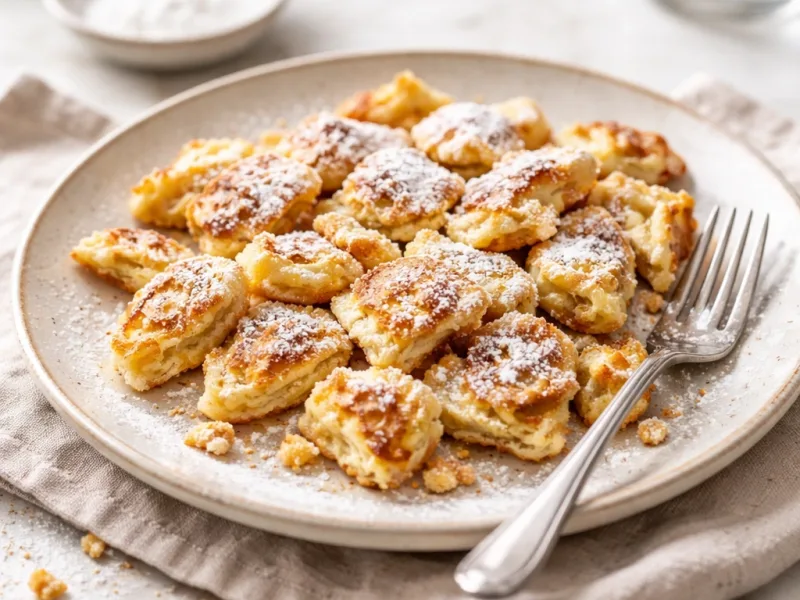
This preparation yields a Kaiserschmarrn that is tender at the center and lightly caramelized on the surface, a balance that makes it suitable both as a sweet main dish and as a shared dessert. The interior stays moist rather than cakey, while the torn edges provide contrast once exposed to the pan. You can judge progress by color and aroma alone: pale batter tones disappear, replaced by an even golden surface and a gentle butter note. The result fits well into the category of an easy Austrian dessert recipe that does not rely on added flavorings or toppings to feel complete.
Portioning supports flexible serving contexts
Once torn, the batch naturally divides into irregular pieces that make portioning intuitive. This works equally well for plating individual servings or placing the pan in the center of the table. The texture holds for several minutes after cooking, so the dish can be served immediately without rushing. In a breakfast or brunch setting, it behaves similarly to a homemade shredded pancake served hot, offering structure without drying out while other components are plated.
Heat behavior creates structure without baking
The defining technical point is how moderate pan heat sets the batter from the bottom upward while steam lifts the interior. As moisture escapes through the torn surface, browning accelerates at the edges through controlled Maillard reactions. This is why tearing happens after initial setting rather than at the start. When done correctly, the pieces brown without becoming brittle, and the interior remains soft rather than rubbery. This heat flow is what separates a fluffy shredded pancake texture from a flat, dense result.
Familiar pancake references clarify expectations
Cooks familiar with standard breakfast pancakes will recognize the batter behavior, though the finish is distinct. If you know the texture checkpoints from pancakes, the visual cues here feel predictable, just extended in the pan. Those who enjoy a crisper exterior may also appreciate how this differs from waffles, where structure is fixed by a mold rather than tearing. The comparison helps set expectations without changing the method.
Sweetness remains restrained and functional
Sweetness is present but controlled, supporting browning rather than dominating flavor. This allows the dish to remain versatile, suitable for simple finishing or pairing with fruit-based accompaniments if desired. Unlike enriched pancake variations such as cinnamon roll pancakes, the flavor profile here stays neutral and dairy-forward, which keeps the focus on texture and timing rather than added aromas.
Chef PEKIS recommends
Keep the pan heat steady rather than high; excessive heat browns the surface before the interior sets, leading to raw centers. Tear the pancake only after the underside is fully colored, because early tearing releases steam too quickly and flattens the structure. Once torn, short contact with the pan is enough; extended cooking dries the pieces and dulls the buttery aroma. This restraint preserves the intended soft interior.
Storage and make-ahead
This dish is not suitable for make-ahead preparation. Once cooled, the interior moisture redistributes and the torn edges soften, resulting in a dense texture when reheated. If necessary, leftovers can be stored covered in the refrigerator for up to 24 hours, but reheating will not restore the original contrast between soft center and lightly crisp surface.
Served straight from the pan
The first forkful tells you what to expect. This is Kaiserschmarrn, prepared as a pan-torn pancake rather than a baked or layered version, so the pieces arrive uneven and soft. The surface shows light browning where it met fat, while the interior stays pale and tender. On the plate, the contrast is immediate: irregular edges, gentle crumble, and a warm dairy aroma that settles quickly.
Eating it fresh matters because the texture holds for a short window. The torn pieces keep their shape, but the inside remains loose and slightly yielding. As steam escapes, the crumb tightens, so this is a dish meant to be shared without delay. The sweetness stays restrained, leaving room for the egg and butter notes to come through clearly.
At the table, it fits naturally into relaxed meals. It works as a sweet main at brunch or as a simple dessert passed around after a light dinner. Portions feel generous without being heavy, and the lack of added fillings keeps the focus on texture rather than contrast. The plate looks informal, which makes it easy to serve without ceremony.
A familiar comfort for everyday moments
This dish often shows up on quieter days, when the kitchen is already warm and there’s time to sit down. It suits cooler mornings or late afternoons, when something soft and filling feels appropriate without being rich. The torn format makes it easy to portion directly from the plate, inviting a second serving if the timing is right.
What stands out while eating is the balance between softness and surface bite. The edges offer a faint crispness, but never enough to dominate. The interior stays cohesive, not sponge-like, which keeps each bite consistent. That reliability is what makes it return-worthy rather than occasional.
Left on the table, the aroma fades before the flavor does. Butter lingers lightly, sweetness recedes, and what remains is a mild, comforting profile that doesn’t overwhelm. It’s the kind of dish that finishes quietly, without garnish or comment, once the plate is empty.
Questions
Is this recipe suitable for a gluten-free version?
Gluten-free versions work best with structure-supporting flour blends. Wheat flour provides elasticity and steam retention, so gluten-free blends must include binders like xanthan gum. Without them, moisture escapes too quickly and the interior becomes crumbly. In US kitchens, pancake-style gluten-free blends labeled “all-purpose” perform more reliably than single flours. Expect slightly less lift and faster browning due to starch composition.
Why does my shredded pancake turn dry after tearing?
Dry texture usually comes from tearing too early or excessive heat. When the base has not fully set, steam escapes before the interior stabilizes. This reduces internal moisture and firms the crumb. Medium stovetop heat common on US ranges allows steam to lift the batter first, then browning to finish exposed edges. Waiting for a stable base preserves softness.
Can I make this with low-fat milk or milk alternatives?
Lower-fat liquids reduce richness and surface browning. Fat carries flavor and slows moisture loss, so skim milk or thin plant milks produce a paler surface and drier mouthfeel. In US supermarkets, barista-style oat milk performs better because added fats mimic dairy behavior. Expect less aroma and a softer crust compared to whole milk.
Why does it lose quality quickly after cooking?
Texture decline happens as steam dissipates and starches firm. This dish relies on trapped moisture rather than crust protection. Once off heat, evaporation accelerates and the crumb tightens. In typical indoor conditions, quality drops within 10–15 minutes. Keeping pieces loosely covered retains warmth but cannot fully prevent moisture loss.
Recivelle · /recipe/kaiserschmarrn-easy-homemade-shredded-pancake