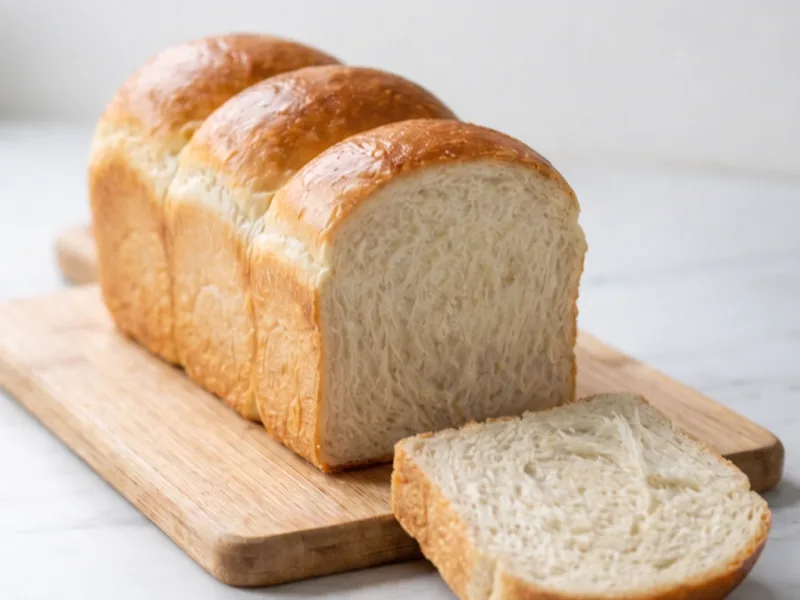
Base recipe: 1 loaf (12 slices)
Your kitchen companion
Ingredients
Check off ingredients as you prepare them.
Follow the steps at your own pace.
Method
Cook Tangzhong: In a small saucepan, combine 1/4 cup (35 g) bread flour and 1/2 cup (120 ml) milk. Heat on medium, stirring with a whisk until the mixture reaches 149°F (65°C) and thickens into a smooth paste. The mixture should leave visible lines when stirred.
Cool Tangzhong: Transfer the paste to a bowl and let it cool to room temperature (68–72°F / 20–22°C). Cooling prevents yeast deactivation.
Mix dough: In a mixing bowl, combine remaining 2 1/2 cups (315 g) bread flour, remaining 1/2 cup (125 ml) milk, 3 tbsp (45 g) sugar, 1 tsp (6 g) salt, 2 tsp (7 g) yeast, and 1 egg (50 g). Add the cooled Tangzhong and mix using a dough hook or spoon until a rough dough forms.
Knead dough: Knead on medium speed or by hand until smooth and elastic, about 8–10 minutes. The dough should stretch into a thin windowpane without tearing.
Incorporate butter: Add 3 tbsp (45 g) softened butter gradually while kneading. Continue kneading until the dough becomes glossy and fully elastic. Dough should feel soft and slightly tacky, not sticky.
First rise: Place the dough in a lightly greased bowl, cover, and let it rise at 75°F (24°C) until doubled in size, about 60 minutes. Dough should spring back slowly when pressed.
Divide dough: Turn dough onto a work surface and divide into 3 equal pieces using a bench scraper. Each portion should be uniform in size for even baking.
Rest portions: Cover the portions and let them rest for 10 minutes at room temperature. This relaxes gluten for easier shaping.
Shape dough: Flatten each portion into a rectangle, roll tightly into cylinders, and place seam-side down into a 9×4×4 inch (23×10×10 cm) loaf pan. Ensure slight spacing between rolls.
Final rise: Let the dough rise at 75°F (24°C) until it reaches 80–90% of pan height, about 45–60 minutes. When gently pressed, the dough should slowly spring back.
Bake loaf: Bake in a preheated oven at 347°F (175°C), conventional mode, middle rack, for 25–30 minutes. Internal temperature should reach 199–203°F (93–95°C). The crust should be light golden and flexible.
Cool loaf: Remove the bread from the pan immediately and cool on a wire rack for at least 60 minutes. Cooling stabilizes the crumb and prevents collapse.
Extra technique, safety notes and details when you want to go deeper.
More tips & details
The Secret to the World’s Softest Loaf
Master the Tangzhong Method for Pillowy Perfection
If you have already mastered the basics of a classic homemade bread, you know that great texture is all about hydration. Japanese milk bread takes this a step further using the Tangzhong method—a simple starter made by pre-cooking a small portion of flour and liquid. This creates a "roux" that locks in moisture, resulting in a pillowy soft bread with a signature shreddable interior and an incredible shelf life. For a beginner, this is the ultimate hack: the pre-gelatinized starch makes the dough more forgiving and ensures your loaf stays fresh and elastic for days. You’ll know the hydration is perfect when the dough feels slightly tacky to the touch but doesn't stick to your fingers.
The Science of a Rich, Enriched Crumb
Unlike leaner loaves, this dough is enriched with whole milk, unsalted butter, sugar, and egg. These ingredients do more than just add a heavenly, milky aroma; they actually modify the gluten behavior to create a fine, uniform crumb. Instead of large, irregular holes, you get a tight, cloud-like texture with feather-light layers that pull apart beautifully. As the bread bakes, the fats stabilize gas retention, leaving you with a thin and flexible crust rather than a crunchy one. It is a sensory delight—sweet, buttery, and remarkably soft.
Shaping for Symmetry and Shreddable Layers
The magic of the "shokuspan" look comes from dividing the dough into three equal portions ($115\text{ g}$ each). By rolling these into tight cylinders, you create internal tension that supports a layered structure and an even rise. When you look at the finished loaf, you should see three distinct, golden domes. This subtle irregularity is the mark of a hand-shaped artisan loaf. These rolls aren't just for show; they form the internal strands that allow you to "shred" the bread into delicate ribbons of dough.
Perfect Timing: The Proof and the Bake
Patience is your best ingredient during the final proof. The dough should rise until it reaches about 80–90% of the pan height—roughly 9 cm ($3.5\text{ inches}$) tall. If you press it gently, it should spring back slowly; this confirms the volume expansion is just right. We bake at a moderate 175°C ($347°F$) to set the structure without hardening the crust. The goal is a light golden surface and an internal temperature of 93–95°C ($200–203°F$), ensuring the center is fully baked while the outside stays tender and moist.
Chef PEKIS Professional Tips
- Cool the Roux: Always let your Tangzhong cool to room temperature before mixing. If it's too warm, it will weaken the yeast activity and ruin the rise.
- Watch the Temp: Keep your kitchen and dough around 24–26°C ($75–79°F$). Overheating the dough during kneading can break down the gluten and lose that essential surface elasticity.
- Don't Rush: A rushed final proof leads to a dense, heavy crumb. Let the dough take its time to achieve that ultra-soft milk bread texture.
Stays Fresh for Days: Storage and Freezing
Thanks to the Tangzhong method, this bread resists staling far better than standard loaves. It remains soft and delicious for 2–3 days at room temperature when kept in a sealed container. The starch stays "gelled" longer, maintaining that moist mouthfeel. If you want to save it for later, freezing is your best option. Simply slice the loaf once cooled and freeze; the slices will keep their structure and softness perfectly once thawed. Avoid the refrigerator, as the cold air actually speeds up the firming of the starch!
Served warm with a soft, pull-apart crumb
Slices of Japanese milk bread arrive at the table as a baked, enriched loaf shaped into three joined sections rather than a single block. The crumb separates in fine strands, showing a shreddable interior that pulls cleanly without crumbling. When cut, the surface yields easily under the knife, and the slice holds together without tearing. The crust remains thin and flexible, bending slightly instead of cracking, which confirms proper structure and moisture balance.
Balanced texture for breakfast and light meals
At the table, the bread adapts easily to both sweet and savory settings. Its mild dairy note supports butter, jam, or soft spreads, while the fine crumb structure prevents toppings from soaking through. A slice maintains shape when lifted, yet compresses lightly under pressure, indicating stable hydration. This makes it suitable for toast or sandwiches where a soft but resilient base is required.
The interior remains consistent from edge to center, without dry zones or dense pockets. Each portion shows even layering from shaping, creating a uniform bite throughout. The crust stays delicate rather than crisp, allowing the focus to remain on the interior texture. When handled, the slice folds slightly before returning to form, confirming elasticity without excess moisture.
Served fresh, the loaf presents a light golden crust and a soft, cohesive crumb that separates into strands with minimal resistance. The structure supports repeated slicing without breaking apart, making it practical for shared serving. The surface remains smooth with slight natural variation, reflecting hand shaping rather than mechanical uniformity.
Questions
Why is Japanese milk bread not soft and fluffy after baking?
The loaf turns firm when gluten is insufficiently developed or hydration is misbalanced. Tangzhong requires strong gluten to support higher moisture; otherwise, the structure tightens during baking. A properly developed dough stretches into a thin, translucent film without tearing, which ensures gas retention and soft crumb formation. Bake only after full proofing, when the dough shows slow spring-back under light pressure. Chef tip: If dough resists stretching early, extend kneading instead of adding flour.
Can Japanese milk bread be made without egg and keep the same texture?
Egg removal reduces emulsification, directly affecting crumb softness and structural stability. Without egg proteins, fat and water do not bind as effectively, resulting in a slightly drier and less cohesive crumb. A replacement such as yogurt maintains moisture but does not fully replicate elasticity. Expect a softer crust but a less structured interior.
Why does Japanese milk bread collapse or shrink after baking?
Collapse occurs when internal structure cannot support retained steam and gas after baking. Over-proofing weakens gluten, and excess moisture from Tangzhong amplifies structural instability during cooling. The loaf must enter the oven before reaching full pan height to maintain strength. A stable loaf holds its shape and does not sink when removed from the pan. Chef tip: Bake when the dough reaches about 85% of pan height, not higher.
Why is Tangzhong not thickening properly in milk bread preparation?
Tangzhong fails when temperature does not reach starch gelatinization point. Below 149°F (65°C), flour does not absorb water effectively, resulting in a thin mixture that cannot improve texture. Proper Tangzhong forms a smooth, thick paste that holds lines when stirred. Without this stage, the dough behaves like standard enriched bread with reduced softness and shelf life.
Recivelle · /recipe/japanese-milk-bread-recipe-easy-make-home