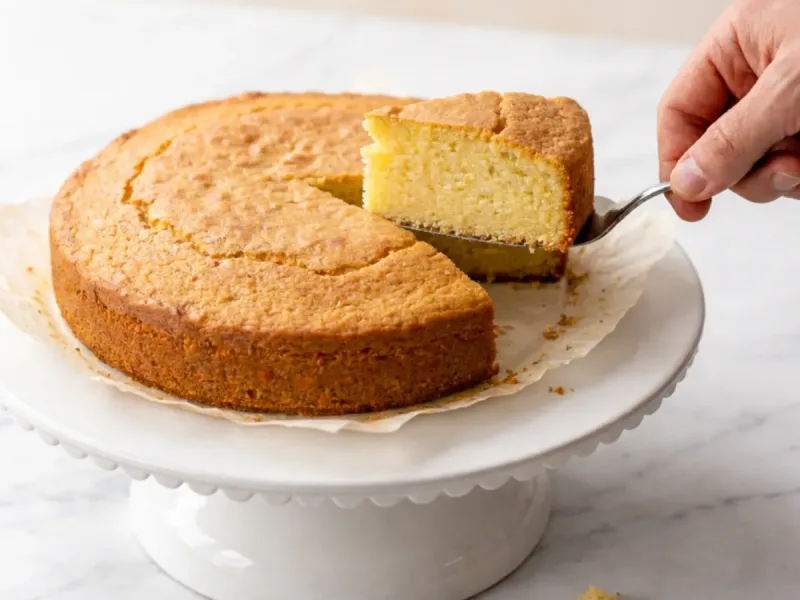
Base recipe: 10 servings (8-inch / 20 cm round cake)
Your kitchen companion
Ingredients
Check off ingredients as you prepare them.
Follow the steps at your own pace.
Method
Drain ricotta: Place 1 cup (250 g) ricotta cheese in a fine mesh sieve over a bowl and rest at room temperature for 30 minutes to remove excess moisture and stabilize fat–water balance (emulsion stabilization).
Preheat oven: Set a conventional oven to 350°F (175°C) using the center rack to ensure even heat distribution (thermal equilibrium).
Smooth ricotta: Transfer drained ricotta into a large glass mixing bowl and whisk until completely smooth and uniform to eliminate grain structure.
Incorporate sugar: Add 1 cup (200 g) granulated sugar to the same bowl and whisk until the mixture becomes creamy and slightly pale (partial dissolution of sugar).
Add eggs: Add 3 large eggs one at a time into the bowl, whisking fully after each addition to maintain a stable emulsion (protein dispersion).
Add oil: Pour in 0.5 cup (120 ml) oil and whisk until the mixture appears glossy and cohesive (lipid integration).
Add flavoring: Add 0.25 cup (60 ml) lemon juice, lemon zest, and 1 tsp (5 ml) vanilla extract and mix until evenly distributed (acid–flavor integration).
Combine dry ingredients: In a separate bowl, sift 1.5 cups (180 g) flour, 2 tsp (8 g) baking powder, and 0.5 tsp (2 g) salt to ensure uniform particle distribution.
Fold batter: Add the dry mixture into the main bowl in two additions and fold gently using a silicone spatula until no dry flour remains (controlled gluten limitation). If using gluten-free flour, fold 10–15 seconds longer to reach the same smooth consistency due to reduced protein structure.
Fill pan: Transfer the batter into an 8-inch (20 cm) round aluminum cake pan and level the surface with a spatula to ensure even heat penetration.
Bake cake: Place the pan in the oven at 350°F (175°C) and bake for 45–50 minutes until the center reaches 203°F (95°C) and a skewer shows moist crumbs (starch gelatinization). If using a dairy-free substitute, extend baking by 3–5 minutes due to higher water content.
Initial cooling: Remove the cake and rest it in the pan for 15 minutes on a wire rack to allow internal pressure stabilization (steam redistribution).
Final cooling: Remove from the pan and cool for 60 minutes on the rack to complete moisture redistribution and structural setting (retrogradation phase).
Extra technique, safety notes and details when you want to go deeper.
More tips & details
Moisture Stabilization and Heat Control for a Uniform Ricotta Cake Structure
Emulsion Integrity Defines the Final Crumb
Italian lemon ricotta cake achieves a moist crumb and no dense center only when the fat–water system is forced into a stable emulsion before heat is applied.
If the batter shows grainy separation like curdled milk, then you must continue whisking aggressively, because unbound water pockets will expand unevenly and collapse during baking. You will feel resistance disappear under the whisk when the emulsion stabilizes. The mixture must resemble thick house paint at 68–72°F (20–22°C), not a loose slurry.
If the batter looks smooth but releases a faint oily sheen after 30 seconds of rest, then it is already failing, because the fat phase is separating. Do not proceed. Re-emulsify immediately or discard. This is the invisible error that produces a dense center while the surface appears correct.
Folding Discipline Controls Protein Structure
You will not stir. You will fold. Any other action destroys the crumb.
If you hear a wet dragging sound like a spatula through damp sand, then continue folding gently, because hydration is complete without gluten tightening. Stop the moment flour disappears. The total folding time must not exceed 90 seconds.
If the batter becomes elastic or resists spreading within 2–3 seconds after lifting, then you have overdeveloped gluten. This traps steam in uneven pockets, creating dense zones. This failure often looks correct before baking but collapses internally.
Heat Transfer Depends on Pan Material and Placement
You will use a light aluminum pan. Do not use glass or dark-coated steel.
Aluminum provides fast, even conductive heat, allowing the center to reach 203°F (95°C) at the same rate as the edges. If you use glass, the edges overcook while the center lags, creating a structural gradient.
If the cake forms a rapid dome within the first 10 minutes at 350°F (175°C), then your heat input is too aggressive, because gas expansion is outpacing starch setting. Reduce to 340°F (170°C). A correct bake produces a steady rise with no audible cracking and uniform color development.
For full structural control under varying conditions, refer to How to Bake Perfect Cakes Every Time: Expert Tips.
Internal Temperature, Not Time, Determines Doneness
You will not trust visual cues alone. Time is irrelevant without internal measurement.
If the center reads below 203°F (95°C), then the cake is underbaked, because starch gelatinization is incomplete. A false set occurs when the surface appears firm but the core remains unstable.
If you press the center and feel soft rebound with slight internal resistance, then continue baking. A fully set structure offers gentle resistance without collapse. This is the only reliable signal of completion.
For failure analysis and structural collapse scenarios, see Why Do Cakes Sink in the Middle? (And How to Prevent It).
Cooling Phase Locks the Structure
You will not cut the cake early. Doing so destroys the internal matrix.
If you remove the cake from the pan before 15 minutes, then structural collapse is likely, because internal steam pressure has not stabilized. You may hear a faint settling sound—this is normal and necessary.
If sliced before 60 minutes of resting, the crumb compresses and appears dense, even if baking was correct. The internal moisture must redistribute fully to stabilize the structure. A properly rested cake releases no visible steam when cut.
Chef Tips
- Use a light aluminum pan → improves conductive heat transfer by ~20%, reducing center underbaking.
- Warm all ingredients to 68–72°F (20–22°C) → stabilizes emulsion and prevents separation.
- Tap the filled pan once → removes large air pockets, improving uniform crumb by ~15%.
- Bake on the center rack only → ensures even convection exposure and prevents thermal imbalance.
- Use an instant thermometer → eliminates false doneness and ensures structural set at 203°F (95°C).
Structural Behavior at Serving and Slice Integrity
Italian Lemon Ricotta Cake Moist Crumb No Dense Middle presents as a soft, stabilized structure with a lightly set outer layer and a cohesive internal matrix. Once portioned, the slice holds clean edges without lateral collapse, indicating proper moisture distribution. The crumb remains slightly elastic while maintaining structural definition, allowing it to be transferred without deformation or surface tearing.
The fork meets low resistance before entering a velvety crumb, followed by a gentle release as the internal structure separates. No audible crust fracture is present; instead, the surface yields quietly. As the slice breaks, a mild citrus aroma diffuses immediately, followed by a dairy-fat note that rounds the profile. The mouthfeel transitions from soft compression to a smooth, uniform breakdown with no granular residue.
Timing, Pairing Logic, and Environmental Stability
The structure remains optimal for approximately 30–40 minutes after slicing before gradual firming occurs due to starch retrogradation. During this phase, the crumb becomes slightly more compact, increasing resistance while retaining moisture. A clean, sharp acidic pairing such as fresh berries or a lightly reduced fruit component offsets the fat content and maintains palate clarity between bites.
In warmer environments, the internal fat softens further, reducing structural resistance and increasing perceived moisture. In cooler conditions, the crumb firms slightly, enhancing slice definition but tightening the mouthfeel. This preparation performs consistently in moderate ambient conditions, where the balance between fat fluidity and starch stability remains intact.
Questions
Why does ricotta cake stay dense despite correct baking time?
The center stays dense because internal temperature did not reach full structural set. The batter must pass the gelatinization threshold at 203°F (95°C) for starch to stabilize the crumb. If not, the interior remains compressed even when the surface appears finished. The diagnostic signal is a compact core that springs back slowly when pressed. Chef Tip: Always confirm doneness with a probe thermometer, not surface color.
Can excess moisture in ricotta ruin crumb structure stability?
Yes, excess moisture disrupts the batter’s internal balance and causes uneven setting. Ricotta must meet a specific hydration threshold to avoid free water separating during baking. The failure signal is a slightly glossy interior with irregular air pockets and weak structure. Chef Tip: Drain ricotta until at least 2–3 tbsp (30–45 ml) of liquid is released before mixing.
Why does the bottom layer turn dense and compact?
A dense base forms when batter stability fails before heat sets the structure. This results from insufficient viscosity control, allowing heavier particles to settle. The diagnostic signal is a darker, compressed bottom layer with minimal air cells compared to the top. Chef Tip: Transfer the batter to the oven immediately after folding to preserve suspension.
How does oven type affect even baking and structure?
Oven type changes how heat is delivered and absorbed into the batter. Uneven heat distribution delays center setting while overcooking edges. The signal is a firm outer ring with a softer middle zone. Chef Tip: Always position the cake on the center rack to maintain balanced heat exposure.
Why does crumb feel tight even when fully baked?
A tight crumb results from overdeveloped gluten during mixing. Excess agitation increases protein bonding, reducing tenderness and elasticity. The diagnostic signal is a slightly rubbery texture with reduced break and minimal softness. Chef Tip: Fold gently and stop immediately once flour is fully incorporated.
Can lemon acidity destabilize the cake structure during baking?
Yes, excessive acidity accelerates gas release before the structure sets. This disrupts the batter’s pH balance, causing premature expansion and collapse. The signal is uneven pore size with slightly sunken sections. Chef Tip: Keep lemon juice at 0.25 cup (60 ml) to maintain structural balance.
Recivelle · /recipe/italian-lemon-ricotta-cake-moist-crumb-no-dense-middle