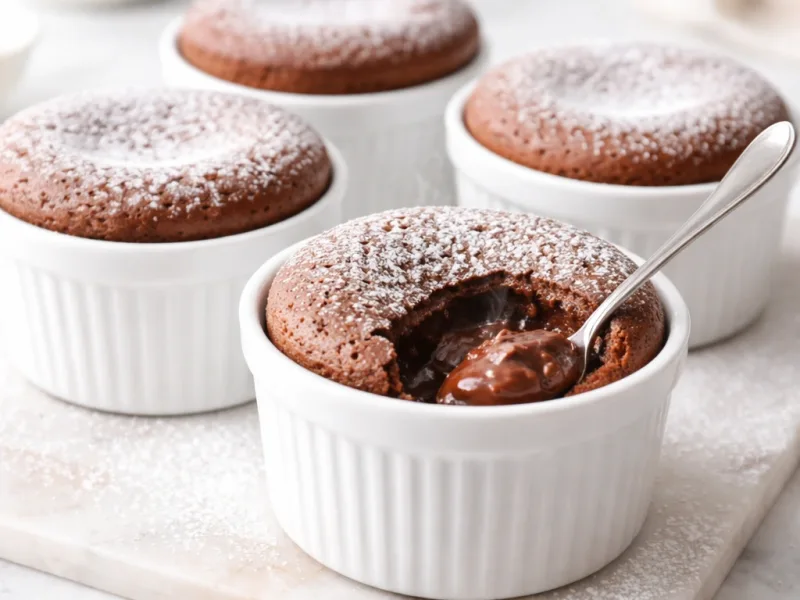
Base recipe: 4 servings
Your kitchen companion
Ingredients
Check off ingredients as you prepare them.
Follow the steps at your own pace.
Method
Prepare the ramekins: Butter 4 ceramic ramekins (180 ml each) thoroughly with part of the unsalted butter, then coat evenly with a thin layer of white sugar taken from the 60 g total. Tilt and rotate each ramekin so the sugar sticks to the butter. The surface should look evenly coated and slightly grainy. This helps the soufflés climb evenly instead of sticking.
Melt chocolate and butter: Place 4.2 oz (120 g) dark chocolate and the remaining 2.8 tbsp (40 g) unsalted butter into a heatproof bowl. Melt gently over a water bath on low heat (water barely simmering) for 4–5 minutes, stirring slowly with a spatula. The mixture will look smooth, glossy, and fully fluid with no lumps. If it thickens, remove from heat and stir until smooth.
Heat the milk: Pour 1/2 cup (120 ml) whole milk into a small saucepan and heat on medium for about 3 minutes until hot but not boiling. Steam should rise and the aroma should be milky and clean, not scorched.
Cook the roux: In a small saucepan, melt 2 tbsp (20 g) butter over medium-low heat. Add 2 tbsp (20 g) all-purpose flour and whisk continuously for 1 minute. The mixture will look smooth and pale with no raw flour smell. If it darkens, reduce heat immediately.
Form the chocolate base: Gradually whisk the hot milk into the roux in three additions. Cook for 1–2 minutes, whisking constantly, until thick and smooth like custard. Remove from heat and whisk in the melted chocolate mixture, 1 tsp (5 ml) vanilla extract, and 1/4 tsp (1 g) salt. The mixture will look glossy and uniform.
Add egg yolks: Whisk in 3 egg yolks one at a time. After each addition, whisk until fully absorbed. The mixture should look silky and slightly lighter in color. If it separates, whisk firmly for 20 seconds until smooth again.
Whip egg whites: Place 4 egg whites in a clean bowl. Whip on medium speed for 1 minute until foamy, then gradually add the remaining white sugar. Continue whipping for 2–3 minutes to soft-medium peaks. The whites should look glossy and hold a peak that gently bends over.
Fold the batter: Fold one-third of the whipped egg whites into the chocolate base using a spatula, folding from bottom to top. Add the remaining whites and fold gently until just combined. The batter should look airy and evenly colored. Do not stir. If it becomes runny, it has been overmixed.
Fill the ramekins: Divide the batter evenly between the prepared ramekins, filling just below the rim. Level gently with a spatula. The surface should look smooth and light.
Bake the soufflés: Place ramekins on a baking tray and bake in a preheated conventional oven at 190 °C (375 °F) on the lower-middle rack for 11–13 minutes. The soufflés are ready when fully risen with set edges and a slight wobble in the center. If tops are pale, bake 2 minutes longer.
Serve immediately: Remove from the oven and serve within 2–3 minutes. The centers will be creamy and steaming. Waiting longer will cause natural deflation, which is expected.
Extra technique, safety notes and details when you want to go deeper.
More tips & details
A Foolproof Chocolate Soufflé for Confident Home Baking
Light, airy, and deeply chocolatey with a soft, molten heart
Easy Chocolate Souffle That Never Fails delivers everything people search for in a classic chocolate soufflé recipe: dramatic rise, rich cocoa flavor, and a texture that feels luxurious without being heavy. The balance between structure and softness is intentional. Carefully chosen ingredients work together so the soufflés rise evenly, hold their shape long enough to serve, and still reveal that irresistible creamy interior when the spoon breaks through the center.
This soufflé is built around dark chocolate, which gives depth and intensity rather than sweetness alone. Butter adds richness and a smooth mouthfeel, while milk and flour form a stable base that protects the soufflé from collapsing too quickly. Eggs are the real engine here: yolks provide body and color, while whipped whites trap air and create that signature lift. Sugar does more than sweeten; it stabilizes the foam and helps achieve a consistent rise, making this a truly reliable chocolate soufflé for home cooks.
Unlike more fragile restaurant-style versions, this method is designed for real kitchens. The batter can be prepared calmly, the folding process is forgiving, and the baking window is wide enough to avoid panic. The result is a dessert that feels impressive yet approachable, perfect for dinner parties, romantic dinners, or when you want a show-stopping chocolate dessert without complicated steps.
Why you’ll love this recipe
- Consistent rise with no collapsing drama
- Deep chocolate flavor without overpowering sweetness
- Soft, creamy center that stays spoonable
- Works well for both special occasions and confident everyday baking
- Ideal if you’re searching for an easy baked chocolate dessert that still feels elegant
The appeal of chocolate soufflé goes beyond technique. It’s the moment it comes out of the oven—puffed, warm, and fragrant—that makes it unforgettable. Historically, soufflés emerged from French kitchens in the eighteenth century, where chefs explored how beaten eggs could transform simple mixtures into light, airy dishes. Chocolate versions became especially popular as cocoa became more widely available, turning the soufflé into a symbol of refined yet comforting indulgence.
In terms of flavor pairing, the intensity of chocolate benefits from contrast. If you enjoy serving multiple desserts or want a lighter follow-up option, the brightness of a citrus-based cream like this creamy lemon dessert creates a refreshing balance after the warmth of chocolate. The contrast between airy cocoa and smooth citrus cream keeps the overall dessert experience elegant rather than heavy.
Chef PEKIS Expert Tips
- Use chocolate with a high cocoa percentage for structure and depth
- Ensure egg whites are whipped to soft peaks for easier folding
- Always bake immediately to preserve trapped air
- Serve straight from the oven for maximum height and drama
Chocolate lovers often compare soufflé to other molten-centered desserts, but the experience is distinct. A molten chocolate cake delivers richness and density, while soufflé focuses on lightness and volume. Understanding this difference helps set expectations and highlights why soufflé remains a timeless favorite for those who appreciate texture as much as flavor.
Why this method works
- A stabilized base prevents premature collapse
- Sugar supports egg-white structure during baking
- Controlled oven heat allows even expansion
- Individual ramekins ensure consistent results across servings
Common mistakes to avoid
- Overwhipping egg whites, which makes folding difficult
- Opening the oven door too early, causing sudden temperature loss
- Under-buttering ramekins, leading to uneven rise
- Waiting too long to serve after baking
Storage and make-ahead
Chocolate soufflé is best enjoyed immediately, but parts of the preparation can be planned ahead. The chocolate base can be prepared earlier and kept refrigerated, tightly covered, for several hours. Egg whites should always be whipped fresh to maintain volume. Fully baked soufflés are not suitable for storage, as their structure is intentionally delicate. If time is short and you’re craving chocolate without baking, a quick chocolate mug cake satisfies that need with minimal effort, though it offers a very different texture and experience.
The beauty of this recipe lies in its balance: technique without intimidation, elegance without excess, and flavor that speaks for itself.
Why This Chocolate Souffle Stands Out
A well-made chocolate souffle is defined by contrast: a gently set exterior that gives way to a soft, almost spoonable center, and a flavor that is rich without being heavy. This version focuses on balance and reliability, combining classic technique with a structure that works in real home kitchens. The result is a dessert that rises confidently, bakes evenly, and delivers deep cocoa notes with every bite, without requiring professional equipment or last-minute stress.
What makes this souffle especially appealing is how forgiving it is. The method allows a comfortable baking window, so timing feels manageable even when cooking for guests. Ingredients are familiar and accessible, yet when handled correctly they produce a texture that feels refined and restaurant-worthy. The flavor profile is clean and focused, letting dark chocolate remain the star while butter and eggs add roundness and depth.
Ease, Timing, and Serving Flexibility
From start to oven, this recipe fits smoothly into a dinner schedule. Preparation is straightforward, baking is brief, and serving happens immediately, making it ideal when you want a warm dessert without advance chilling or complicated assembly. While the souffle is best enjoyed straight from the oven, parts of the base can be prepared ahead, offering flexibility without compromising quality.
Dietary adjustments are possible within limits. The recipe is naturally vegetarian, and with careful substitutions it can be adapted for gluten-free needs, while still preserving its essential character. These options make it suitable for a wide range of tables without turning it into a different dessert entirely.
When to Serve It
This chocolate souffle shines most when served fresh, warm, and shared at the table. It’s perfect for romantic dinners, small celebrations, or any moment when you want to end a meal with something memorable but not overwhelming. The dramatic rise, inviting aroma, and molten interior create an experience that feels special every time. Simple, elegant, and dependable, it’s a dessert that rewards both the cook and the guests.
Questions
Why did my Chocolate Souffle collapse after baking?
Chocolate Souffle collapses naturally as steam escapes and structure relaxes. Chef’s explanation: Soufflés rely on air trapped in egg whites, which expands at 190 °C (375 °F) and contracts once removed from heat. Serving within 2–3 minutes preserves height; collapse after that is normal and expected.
Can Chocolate Souffle batter be prepared ahead of time?
Chocolate Souffle batter cannot be fully prepared ahead without quality loss. Chef’s explanation: The chocolate base can be made and chilled for up to 6 hours, but egg whites must be whipped and folded just before baking to maintain volume and structure.
Can Chocolate Souffle be frozen after baking?
Chocolate Souffle cannot be successfully frozen after baking. Chef’s explanation: Freezing damages the delicate egg foam structure, causing water separation and a dense texture when reheated, which is unsuitable for classic baked desserts.
What can replace butter in Chocolate Souffle?
Butter has no suitable replacement without altering structure. Chef’s explanation: Butter provides fat stability and flavor; oils or margarine change melting behavior and weaken the emulsion with dark chocolate and flour.
How can I tell when Chocolate Souffle is done baking?
Chocolate Souffle is done when risen, set at edges, and softly wobbly in the center. Chef’s explanation: The top looks dry and lightly cracked The sides are firm to gentle touch The center trembles slightly when shaken If pale, bake 2 minutes longer at 190 °C (375 °F).
Is Chocolate Souffle suitable for gluten-free baking?
Chocolate Souffle can be adapted for gluten-free diets with starch. Chef’s explanation: Replacing all-purpose flour with the same amount of cornstarch works in this vegetarian dessert, though the crumb will be slightly softer and less elastic.
Why does sugar matter in Chocolate Souffle beyond sweetness?
Sugar stabilizes egg whites and supports consistent rise. Chef’s explanation: Sugar strengthens protein bonds in egg whites, allowing them to trap air evenly during baking, which is essential for reliable lift in classic chocolate desserts.
Recivelle · /recipe/easy-chocolate-souffle-never-fails