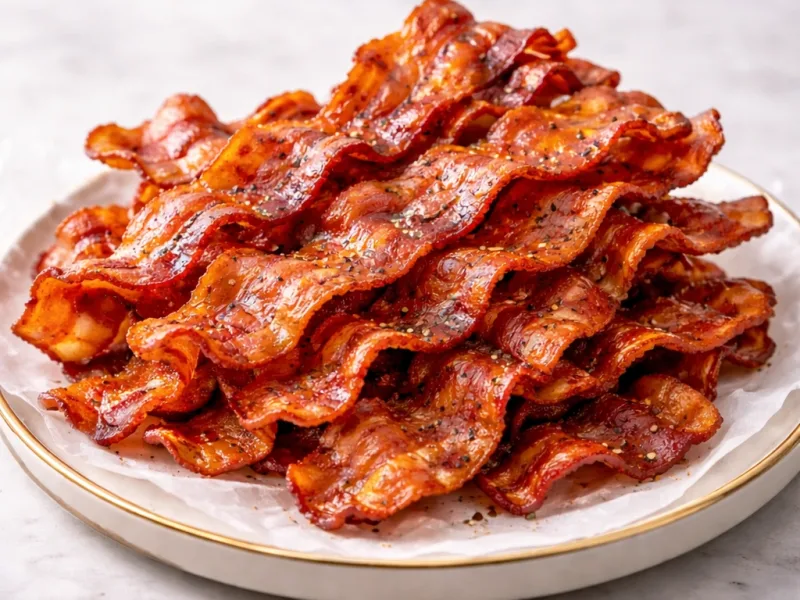
Base recipe: 240 g cooked bacon
Your kitchen companion
Ingredients
Check off ingredients as you prepare them.
Follow the steps at your own pace.
Method
1. Get the heat ready Set your air fryer to 180°C (356°F). Let it run for a few minutes until it’s fully preheated. You want that hot air moving so the bacon starts sizzling the second it hits the basket.
2. Lay them out Arrange your bacon strips in a single layer in the basket. Avoid overlapping—give each strip its own space so the air can wrap around every edge. This is the secret to an even, all-over crunch.
3. Start the render Slide the basket in and cook for 6 minutes. You’ll hear the bacon start to whistle and pop as the fat begins to bubble and the surface looks glossy and shimmering.
4. The mid-way flip Pull the basket out and flip each strip over. Giving them a quick turn ensures both sides get equal time with the heat, preventing any soft or chewy spots.
5. Finish for the "Snap" Cook for another 4–6 minutes. Keep an eye on the color—you’re looking for a deep, even golden-brown. The bacon is done when the surface shifts from a wet-looking gloss to a beautiful matte finish.
6. Drain the excess Transfer the hot strips onto a plate lined with paper towels. Dabbing away the extra oil now ensures a clean, non-greasy bite later.
7. The 2-minute magic Patience is key! Let the bacon rest for 2 minutes at room temperature. As it cools slightly, the fibers tighten up and the fat stabilizes, giving you that perfect, signature snap.
Extra technique, safety notes and details when you want to go deeper.
More tips & details
Perfectly Crispy Air Fryer Bacon: The Ultimate Breakfast Side
Master the Art of Controlled Fat Rendering
Achieving the perfect slice of bacon in an air fryer comes down to one thing: consistent airflow. Unlike pan-frying, the air fryer uses high-velocity hot air to strip away surface moisture while gently melting the fat. You’ll know you’ve hit the "sweet spot" when the strips transform from a glossy raw state to a beautiful matte finish with deeply golden, defined edges. This method ensures a crisp bite that holds its shape without becoming brittle or overly dry.
The Secret to a Balanced Breakfast Plate
Crisp bacon is the essential "texture anchor" for any classic breakfast. It provides the necessary crunch to contrast soft scrambled eggs, creamy avocado, or fluffy toast. For the best experience, serve these strips immediately after their brief rest. This ensures the exterior stays firm and "snappy" while the center retains just enough flexibility for a satisfying chew. Plus, air frying results in a much cleaner plate with significantly less grease transfer than traditional methods.
Why Spacing and Airflow Matter
To get consistent, 10/10 results every time, you must respect the air fryer’s mechanics. Do not overlap your bacon. When strips have space to breathe, the heat remains stable, preventing those dreaded "soggy middle" spots. You are looking for even color development across the entire length of the strip. If the ends are browning faster than the center, your airflow is likely blocked.
Achieving the Perfect "Snap"
The ideal air fryer bacon goes through two phases: controlled dehydration followed by rapid browning. This technique creates a structural integrity that is hard to replicate on a stovetop. You’ve mastered the timing when the bacon holds perfectly straight when lifted with tongs, yet offers a clean "snap" when you bite into it.
Why This Method Wins on Every Level
- Clean Surface Finish: Placing the bacon on absorbent paper immediately after cooking removes residual fat, leaving you with a light, non-greasy strip.
- Uniform Edge Crispness: 360-degree heat exposure ensures the edges are golden-brown and crisp without the bitter taste of burnt tips.
- Structural Stability: A 2-minute rest allows the rendered proteins to set, ensuring your bacon doesn't go limp the moment it hits the plate.
Chef PEKIS’ Pro Tips
Avoid the Stack: Never stack your bacon strips. Trapped steam is the enemy of crispness; it will make your bacon "boiled" and rubbery rather than roasted.
The "Early Pull" Technique: Carry-over cooking is real. Remove your bacon when it looks about 90% done. The residual heat will finalize the crispness during the resting phase, preventing that "over-baked" charred flavor.
Serving and Storage
Air fryer bacon is a "cook-to-order" luxury. We do not recommend refrigeration or long-term storage, as the strips will naturally reabsorb moisture and lose their signature crunch. If you are cooking for a crowd, you can keep the finished strips in a warm, dry oven (uncovered) for up to 30 minutes.
Complete your meal: Pair this classic side with Crispy Air Fryer Asparagus for a fresh green contrast, or go all-out with a side of Extra Crispy Air Fryer Fries.
Best Served While Still Warm
Crispy Air Fryer bacon is presented as a dry-heat cooked preparation without added fat, relying on its own rendering. On the plate, the surface shows firm golden edges with a slight bend through the center, indicating correct structure. When served immediately, the strips hold shape without sticking, and the aroma remains clean and roasted rather than heavy.
Alongside soft eggs or toasted bread, the contrast becomes functional rather than decorative. The bacon provides a defined bite that separates easily, leaving minimal residue on the plate. This makes it suitable for composed breakfast servings where each element maintains its own texture.
Plate Balance and Serving Context
In cooler seasons, it integrates well into heavier breakfast formats with beans or sautéed vegetables, where its structure prevents collapse under moisture. In lighter settings, it pairs with fresh components where crispness must remain intact. The surface remains dry to the touch, a key indicator that excess fat has been properly removed before serving.
When arranged in small stacks or layered across a plate, the strips should not compress under their own weight. This maintains airflow between pieces and preserves the outer texture. A brief resting phase before plating ensures the final bite remains stable, with no softening at the edges.
Questions
Why does my air fryer bacon turn out soft instead of crispy?
Soft texture occurs when moisture is trapped due to overlapping strips or insufficient airflow. Think of your air fryer like a mini convection oven; if you crowd the basket, the bacon ends up "steaming" in its own vapor rather than roasting. To get that signature crunch, every strip needs its own "personal space" so the hot air can whisk away moisture instantly. Chef’s Tip: If you’re short on space, "ripple" the bacon slightly (like an accordion) rather than overlapping them flat. This increases surface area for the air to hit while keeping the footprint small.
Is thick-cut bacon suitable for crispy air fryer bacon strips?
Thick-cut bacon requires extended rendering time to achieve crisp texture. Because there is more internal fat to melt away, a standard "quick cook" will often leave the center chewy while the edges burn. You have to be patient with thick slices—let that fat break down slowly so the entire strip dehydrates evenly. Chef’s Tip: For thick-cut slices, drop the temperature to 170°C (340°F) and add 3–4 minutes to the cook time. The lower heat gives the fat time to render out completely without scorching the meat.
Does preheating really affect the texture of the bacon?
Skipping preheating leads to uneven fat rendering and inconsistent crispness. If you start with a cold basket, the bacon sits in a "warm bath" of rising temperatures, which can make it tough and greasy rather than snappy. A hot start triggers an immediate sizzle, locking in the structure and starting the crisping process the second the drawer closes. Chef’s Tip: Always run your air fryer empty for at least 3 minutes before your first batch. It’s the difference between a "boiled" texture and a professional-grade roast.
Why does my bacon curl up so much during the cooking process?
Curling occurs due to uneven contraction between fat and lean layers under heat. It’s essentially a tug-of-war happening inside the strip—the fat shrinks faster than the muscle, pulling the bacon into a "C" shape. Flipping the strips halfway through relaxes that tension and ensures the heat hits both sides evenly, keeping your strips much flatter. Chef’s Tip: If you want perfectly flat "hotel-style" bacon, place a small stainless steel cooling rack directly on top of the bacon strips inside the basket to weigh them down during the cook.
How do I get even browning without those burnt, bitter edges?
Burnt edges result from excessive localized heat and uneven airflow. Since the tips of the bacon are thinner than the center, they naturally cook faster. If your strips are too close to the heating element or the basket walls, those tips will char before the middle is even rendered. Keep your placement centered and keep a close eye on the color transition. Chef’s Tip: If you notice the ends browning too fast, simply move the strips from the outer edges of the basket to the center during your mid-way flip. The center usually has the most stable airflow.
Recivelle · /recipe/crispy-air-fryer-bacon-strips-classic-breakfast-side