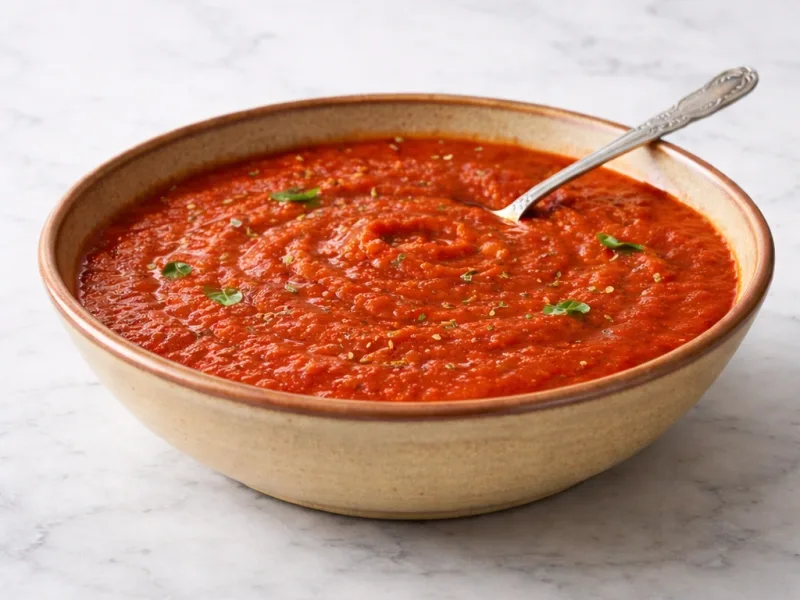
Base recipe: 5 cups (1.2kg) tomato sauce
Your kitchen companion
Ingredients
Check off ingredients as you prepare them.
Follow the steps at your own pace.
Method
Heat olive oil: Place a 24 cm (9.5-inch) heavy-bottom saucepan on the stovetop over medium heat. Add 3 tbsp (45 ml) extra virgin olive oil and heat to 120 °C (250 °F) until fluid and lightly shimmering.
Soften onion: Add 4.2 oz (120 g) finely diced yellow onion. Cook for 8 minutes, stirring regularly, until translucent and soft with no browning.
Bloom aromatics: Add 0.4 oz (12 g) finely minced garlic and 0.07 oz (2 g) dried oregano. Cook for 30 seconds, stirring constantly, until fragrant with no color.
Add tomatoes: Add 28.2 oz (800 g) whole peeled canned tomatoes and 14.1 oz (400 g) tomato passata. Crush the whole tomatoes directly in the pan with a spoon until broken into small pieces.
Season sauce: Add 1.5 tsp (9 g) fine sea salt and 1.5 tsp (6 g) granulated sugar. Stir until completely dissolved and evenly distributed.
Simmer gently: Reduce heat to low and simmer uncovered at 90–95 °C (194–203 °F) for 35 minutes, stirring every 5 minutes and scraping the bottom of the pan. The sauce should coat a spoon evenly; simmer 5 minutes longer if it appears loose.
Finish with basil: Remove the saucepan from the heat. Tear 0.2 oz (6 g) fresh basil leaves by hand and stir into the sauce until evenly mixed.
Rest sauce: Let the sauce rest for 10 minutes to stabilize texture and allow flavors to settle before serving or storing.
Extra technique, safety notes and details when you want to go deeper.
More tips & details
Tomato sauce built for consistent Italian-style results
A smooth, spoon-coating tomato sauce becomes reliable for everyday cooking
Best Tomato Sauce in this style is a stovetop preparation designed to produce a smooth, spoon-coating tomato sauce that holds together without separating. It serves home cooks who need a dependable base for pasta, layered dishes, or simple pan finishes, where consistency matters more than decoration. The sauce is practical because it uses controlled heat and time rather than reduction tricks, giving a predictable result even on a standard home burner.
The finished batch is ready to use warm, directly from the pan, or after a short rest when the surface tightens slightly and the aroma settles. You will know it is on track when the sauce clings to a spoon in an even layer instead of sliding off or breaking into watery edges. This state makes it suitable for both immediate serving and later reheating without loss of structure.
Gentle simmering creates a rich homemade tomato sauce texture
A rich homemade tomato sauce texture depends on moisture loss happening slowly, not aggressively. Gentle simmering allows excess water from the tomatoes to evaporate while the natural pectins thicken the sauce. This process produces body without starch or blending, keeping the flavor clean and tomato-forward.
The key technical behavior is controlled evaporation: when heat stays low, the sauce reduces evenly instead of scorching at the base. The direct effect is a rounded flavor and a surface that looks glossy but not oily. Avoid rushing this phase; faster boiling traps raw acidity and prevents the sauce from developing depth.
Balanced acidity supports an authentic Italian tomato sauce base
An authentic Italian tomato sauce base relies on balance rather than intensity. Tomatoes bring natural acidity, onions soften into sweetness over time, and olive oil rounds the edges. When these elements are allowed to settle together, the sauce becomes stable enough to carry other ingredients without dominating them.
This balance matters when the sauce is used beyond a single serving. In dishes like Classic Italian Lasagne Recipe – Authentic & Easy, the sauce must stay cohesive through baking without leaking liquid into the layers. The same stability helps when spreading a thin layer for pizza or folding into filled pasta.
One batch adapts easily to multiple serving contexts
This preparation is designed as a flexible base rather than a finished plate. It works equally well as a pasta coating, a baking layer, or a topping applied in a thin, even film. When paired with starches, the sauce should coat rather than pool, which keeps plates clean and portions controlled.
For oven dishes such as Baked Gnocchi with Tomato Sauce and Mozzarella, the sauce maintains its body under heat and does not release excess moisture into the baking dish. On pizza, it spreads smoothly and stays in place during baking, supporting toppings without soaking the dough, as seen in Homemade Pizza with Prosciutto – Easy Italian Recipe.
Chef PEKIS recommends
Keep the heat lower than you think you need once the tomatoes are added; steady simmering prevents bitterness and keeps the color clean. Stir to the bottom of the pan at regular intervals so the sauce thickens evenly rather than concentrating at the base. If the surface starts to darken too quickly, the heat is too high and the flavor will turn sharp instead of rounded.
Storage and make-ahead
This sauce is suitable for make-ahead use. Store covered in the refrigerator for up to 5 days once fully cooled, or freeze in airtight containers for up to 3 months. Proper cooling before storage preserves texture and prevents separation during reheating.
At the Table, Not on the Stove
The first spoonful tells you what you need to know. Best Tomato Sauce here means a stovetop sauce, not a baked or blended one, meant to be ladled warm and shared immediately. The surface settles into a soft gloss, and the aroma stays focused on tomato rather than herbs. On the plate, it spreads evenly without running, which makes it easy to pair with pasta, bread, or a simple vegetable side without dominating the rest of the meal.
As it sits, the texture holds. The sauce does not thin out or form a watery ring at the edge of the plate. That stability matters when serving family-style, where bowls are passed and portions are not rushed. The mouthfeel stays rounded, with just enough body to coat food evenly and leave a clean finish after each bite.
When and How It Fits the Meal
This sauce works best when the table is casual and flexible. It suits weeknight dinners where plates are filled in stages, or longer meals where conversation slows the pace. Its flavor profile stays steady even as it cools slightly, so there is no pressure to eat fast. The balance makes it easy to serve alongside sharper elements like cheese or cured meats without clashing.
Leftovers, if they reach the next day, feel familiar rather than tired. The texture remains intact, and the flavor does not flatten. When reheated gently, the sauce returns to its original state, with the same smooth texture and a warm, clean aroma. It feels appropriate for both quiet meals and shared tables, adapting to the moment without asking for attention.
Questions
Is this tomato sauce suitable for gluten-free cooking?
Gluten-free suitability depends on ingredient composition, and this sauce contains no gluten sources. Tomatoes, olive oil, vegetables, and herbs do not introduce gluten proteins. The texture is created through natural pectin thickening rather than flour or starch, which avoids cross-category issues. In practice, this makes the sauce safe for gluten-free pasta or baked dishes. Always verify packaged tomato products for cross-contamination if strict dietary control is required.
Why does my sauce sometimes taste sharp or acidic?
Sharp acidity comes from excessive heat reducing water faster than sugars develop. When tomatoes boil hard, acids concentrate while sweetness lags behind. Gentle simmering allows onions to soften and sugars to integrate, smoothing the flavor. Practically, keeping bubbles slow and spaced prevents this imbalance. A rested sauce also tastes rounder because volatile acids dissipate slightly as it cools.
Can I use this sauce straight on pizza without cooking again?
Direct pizza use works because the sauce is already thick and stable. The low-moisture texture prevents soaking into dough during baking. Technically, reduced free water limits steam release in the oven. For best results, spread a thin, even layer; too much sauce insulates the crust and slows browning. Aroma stays clean because basil is already integrated, not raw on the surface.
What causes tomato sauce to separate when reheated?
Separation happens when water and oil lose their emulsion due to rapid reheating. High heat forces oil to rise while water thins underneath. Slow reheating restores cohesion by allowing fats to disperse again. Stirring gently from the base helps redistribute solids. In home kitchens, reheating over low heat avoids breaking the structure formed during simmering.
Is this sauce better smooth or slightly textured?
Slight texture improves cling and mouthfeel compared to fully puréed sauces. Small tomato solids help trap oil and aromatics, giving body without heaviness. Completely smooth sauces often feel thinner unless thickened artificially. Practically, crushing tomatoes by hand leaves enough structure for stability while still reading as smooth on the palate.
Why does resting the sauce improve its consistency?
Resting allows suspended solids to hydrate fully and pectins to finish binding water. Heat keeps molecules active; cooling lets them settle into a stable network. This results in better spoon coating and less surface pooling. In everyday use, even a short rest reduces splatter and makes portioning cleaner.
Recivelle · /recipe/best-tomato-sauce-rich-homemade-italian-style