Base recipe: 4 servings
Your kitchen companion
Ingredients
Check off ingredients as you prepare them.
Follow the steps at your own pace.
Method
Preheat air fryer: Set air fryer to 356°F (180°C) and allow to preheat for 3–5 minutes until hot airflow is stable.
Prepare chicken breasts: Pat 4 chicken breasts (1.3 lb / 600 g) dry with paper towels until the surface is completely dry to promote even browning.
Flatten thickness: Gently pound thicker areas to an even thickness of about 1 inch (2.5 cm) using a meat mallet to ensure uniform cooking.
Apply oil: Coat all chicken breasts evenly with 1 tbsp olive oil (15 ml) to reduce surface drying and improve heat transfer.
Season evenly: Mix 1 tsp salt (6 g), ½ tsp black pepper (2 g), 1 tsp garlic powder (3 g), and ½ tsp paprika (2 g), then apply evenly on all sides of the chicken.
Arrange in basket: Place chicken breasts in a single layer in the air fryer basket (minimum 4 L capacity) without overlapping to allow proper airflow.
Cook first side: Cook at 356°F (180°C) for 10 minutes until the surface begins to turn light golden.
Flip chicken: Turn each piece using tongs to ensure even exposure to circulating heat.
Finish cooking: Continue cooking at 356°F (180°C) for 6–8 minutes until the internal temperature reaches 165°F (74°C) measured at the thickest point; juices should run clear.
Rest chicken: Remove from air fryer and rest for 5 minutes at room temperature to allow juices to redistribute and stabilize moisture.
Extra technique, safety notes and details when you want to go deeper.
More tips & details
Precision cooking method for lean air fryer chicken breast
Why this lean cut requires strict temperature control
This preparation builds on the core thermodynamic principles outlined in our Air Fryer Meat Guide, applying them specifically to lean poultry that lacks protective fat. Chicken breast behaves very differently from fattier cuts, transitioning rapidly from tender to dry the moment its internal temperature exceeds 165°F (74°C). This specific method eliminates that margin of error by utilizing controlled heat, uniform thickness, and a strict resting phase to lock in moisture and ensure a stable, juicy texture.
What makes this version different from classic air fryer poultry
Unlike cooking bone-in or skin-on pieces, this technique removes unpredictable variables like fat rendering and uneven thermal conduction. Because the meat has no natural skin to protect it, a light coating of oil is applied to create a lipid barrier that prevents surface dehydration in the high-airflow environment. The result is a precisely cooked, lightly golden exterior with a firm yet highly moist interior. This moisture-focused approach shares the same structural logic as cooking an Air Fryer Turkey Breast, where preventing moisture loss is the primary goal.
Air fryer chicken breast cooking time and thickness control
Uniform thickness dictates whether the center of the meat reaches its target temperature at the exact same time as the outer layers. Flattening the thicker sections to a consistent 0.8–1.2 inches (2–3 cm) guarantees even heat penetration and stops the thin edges from overcooking. At 356°F (180°C), the optimal cooking window is remarkably tight, generally taking 16 to 18 minutes depending on the exact mass. A correctly executed piece yields a fully opaque white interior that releases clear juices when sliced, showing absolutely no signs of dry, shredding fibers.
Heat transfer and moisture retention explained
The intense circulation of hot air causes rapid surface evaporation, which easily ruins lean proteins if left unmanaged. Applying a thin layer of oil mitigates this moisture loss and improves surface heat conduction, enabling the core to reach its target temperature without severely drying out the exterior. Additionally, applying salt prior to cooking triggers mild protein denaturation, actively helping the muscle fibers hold onto water during the heating process. This chemical interaction produces a stable internal structure that retains its juices upon slicing, rather than flooding the cutting board.
Chef PEKIS recommendations
Always use an instant-read thermometer and remove the meat the exact moment it hits the target temperature; even a 3°F (2°C) overshoot rapidly degrades the texture from tender to dry. Enforce a strict resting period before carving, because slicing prematurely forces the pressurized juices to escape. Never overcrowd the air fryer basket, as restricted airflow prevents proper surface development and causes uneven internal cooking. Finally, for completely reproducible results, you must standardize the thickness of the meat before applying any seasoning.
Storage and make-ahead
Store leftover portions in an airtight container at or below 39°F (4°C) for up to three days to maintain moisture stability. To reheat without compromising the texture, warm the chicken briefly at 320°F (160°C) for just three to four minutes. If preparing these breasts specifically for meal prep, intentionally undercook the meat by 2–3°F (1–2°C), allowing the final reheating process to bring it to a safe, perfectly tender state. You can freeze the cooked chicken for up to two months, though you may notice a slight increase in firmness upon thawing due to inevitable changes in the protein structure.
Clean serving format for lean poultry portions
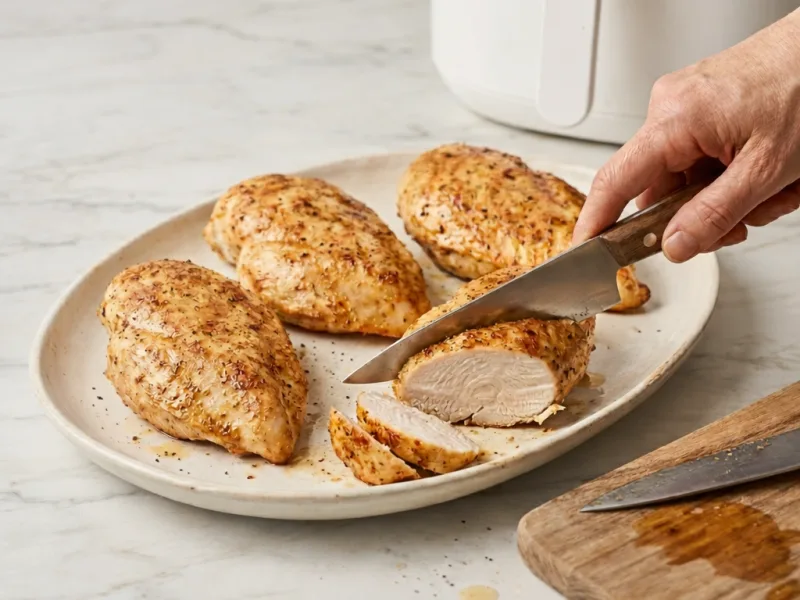
Air Fryer Chicken Breast Juicy and Perfectly Cooked is presented as a boneless, skinless portion designed for clean slicing and controlled serving. This preparation focuses on uniform pieces with no attached skin or bone, allowing each portion to be served whole or sliced across the grain. The result is a structured, lean cut that maintains integrity on the plate without excess surface fat or rendered juices.
The interior shows a moist, firm texture with a slight sheen when cut, while the exterior forms a thin lightly golden surface that remains intact without flaking. Aroma is mild and clean, with subtle roasted notes from the seasoning. When sliced, the meat separates smoothly without tearing, and the surface remains stable rather than releasing visible liquid.
Practical serving use across meals
This preparation fits directly into structured meals where portion control and consistency are required. It can be served as a central protein alongside grains or vegetables, or sliced for use in salads, wraps, or plated lunches. The clean surface and stable texture allow it to hold shape when reheated or served at room temperature, making it suitable for advance meal planning.
In colder months, it pairs well with warm sides such as rice or root vegetables, where the firm texture contrasts softer components. During warmer periods, it integrates into lighter dishes without overwhelming other elements. The consistency remains reliable across servings, with each portion maintaining the same internal structure and surface condition after resting.
Questions
Why is air fryer chicken breast dry inside?
Air fryer chicken breast turns dry when internal temperature exceeds 165°F (74°C) and moisture is expelled. Lean muscle fibers contract quickly under high heat, forcing out internal juices with no fat to protect them. This results in a dull, fibrous interior with no surface sheen. Remove at target temperature and rest properly; correctly cooked meat shows a slight gloss and clean slicing without shredding. Chef tip: Pull the meat at exactly 165°F (74°C) and allow resting to finish stabilization.
How long to cook air fryer chicken breast evenly?
Air fryer chicken breast cooks evenly when thickness is uniform and timing matches heat penetration. At 356°F (180°C), a 1 inch (2.5 cm) thick piece requires 16–18 minutes total. Uneven thickness causes edges to overcook before the center reaches temperature. Properly cooked meat shows a consistent white interior with no translucent core and light resistance when pressed.
Why is air fryer chicken breast not browning?
Air fryer chicken breast fails to brown when surface moisture blocks the Maillard reaction. Water creates steam, preventing surface temperatures from rising enough for browning. Dry the surface thoroughly and apply a thin oil layer to support heat transfer. A properly browned piece has a light golden crust with dry edges, not pale or wet patches.
Can air fryer chicken breast be cooked from frozen safely?
Air fryer chicken breast cooked from frozen often results in uneven doneness due to disrupted heat transfer. The outer layer reaches high temperature while the center remains undercooked, causing dryness outside and softness inside. Thawing ensures even cooking. A correctly cooked piece has uniform firmness throughout with no cold or rubbery center when cut.
Why is air fryer chicken breast tough and chewy?
Air fryer chicken breast becomes tough when protein fibers over-contract from excessive heat or extended cooking. This creates a dense, rubbery structure with reduced moisture retention. Maintaining precise temperature prevents this effect. Proper texture should feel firm but yielding, with visible moisture and no stringy resistance when sliced.
How to season air fryer chicken breast for better flavor?
Air fryer chicken breast develops better flavor when salt and oil improve surface adhesion and moisture balance. Salt supports protein structure while oil distributes spices evenly across the surface. Without proper coating, seasoning remains uneven and flavor is inconsistent. A well-seasoned piece shows uniform color and a balanced aroma with no burnt spice spots.
Recivelle · /recipe/air-fryer-chicken-breast