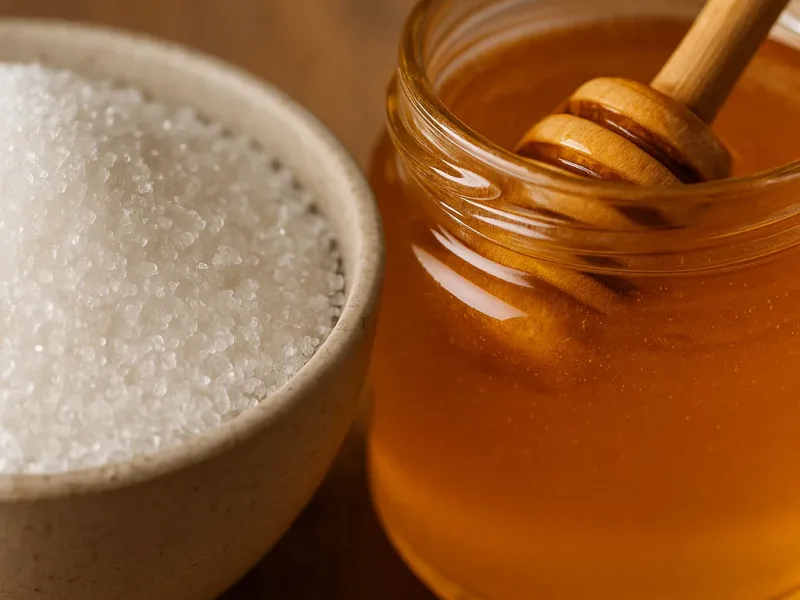
Exploring the role of sugar and honey in cakes, cookies, and bread
When comparing sugar vs honey in baking, the differences go far beyond taste. Both ingredients provide sweetness, but their chemical properties, texture, and nutritional profiles can transform a recipe in unique ways. Bakers who experiment with both quickly realize that the choice between sugar and honey affects browning, moisture retention, and even shelf life. Knowing when to use each makes it easier to achieve the desired flavor, aroma, and structure in baked goods.
Historical background of sugar and honey
Honey has been used as a natural sweetener since ancient civilizations in Egypt, Greece, and Mesopotamia. Its antibacterial properties and floral notes made it both a food and a medicinal ingredient. Sugar, extracted from sugarcane and later sugar beets, became widespread in Europe during the Middle Ages, eventually dominating global baking traditions. While honey is the older of the two, sugar shaped modern pastry, confectionery, and bread making.
Key differences in baking properties
Sweetness and flavor
- Honey is sweeter than granulated sugar, meaning less is needed to achieve the same level of sweetness.
- Sugar provides a neutral sweetness, while honey adds complex notes depending on its floral origin.
Texture and moisture
- Honey attracts and retains moisture, keeping cakes and muffins softer for longer.
- Sugar helps with aeration when creamed with butter, essential for light sponge cakes and cookies.
Color and caramelization
- Honey speeds up browning due to its fructose content, which caramelizes quickly.
- Sugar contributes to controlled caramelization, giving cookies and pastries golden edges and crisp textures.
Nutritional considerations
While both provide calories, honey offers small amounts of minerals and antioxidants, unlike refined sugar. Still, moderation is important since both contribute to overall sugar intake.
Practical ideas and baking tricks
How to substitute sugar with honey
- Use ¾ cup of honey (180 ml) for every 1 cup (200 g) of sugar.
- Reduce the liquid in the recipe slightly, as honey adds extra moisture.
- Lower the baking temperature by 5–10°C (10–20°F) to prevent over-browning.
Flavor combinations that work
- Honey pairs beautifully with whole grains, nuts, and spices such as cinnamon or ginger.
- Sugar works best in recipes requiring stable structure, like meringues, sponge cakes, and shortbread.
Inspiration from traditional and modern cuisine
- Classic European gingerbread often uses honey for depth and chewiness.
- French patisserie relies heavily on refined sugar for precision and consistency.
- Modern healthy baking trends experiment with honey in granola bars, muffins, and rustic bread for added aroma and natural sweetness.
Practical tips for everyday baking
- For moist muffins or banana bread, replace part of the sugar with honey.
- When baking cookies that need a crisp bite, stick to granulated sugar.
- Combine both for balance: sugar for structure, honey for moisture and flavor.
- Store honey-based baked goods in airtight containers to prevent stickiness.
Common mistakes to avoid
- Substituting sugar with honey in equal amounts without adjusting liquids.
- Forgetting to lower oven temperature when using honey.
- Overlooking honey’s strong flavor, which may overpower delicate recipes.
Why both sweeteners have a place in baking
The choice between sugar and honey in baking depends on the type of recipe and the results you want to achieve. Sugar ensures stability and crispness, while honey enhances moisture, adds complexity, and brings a touch of tradition. By combining professional techniques with practical tricks, bakers can confidently adapt recipes, creating desserts that reflect both classic pastry and modern innovation.