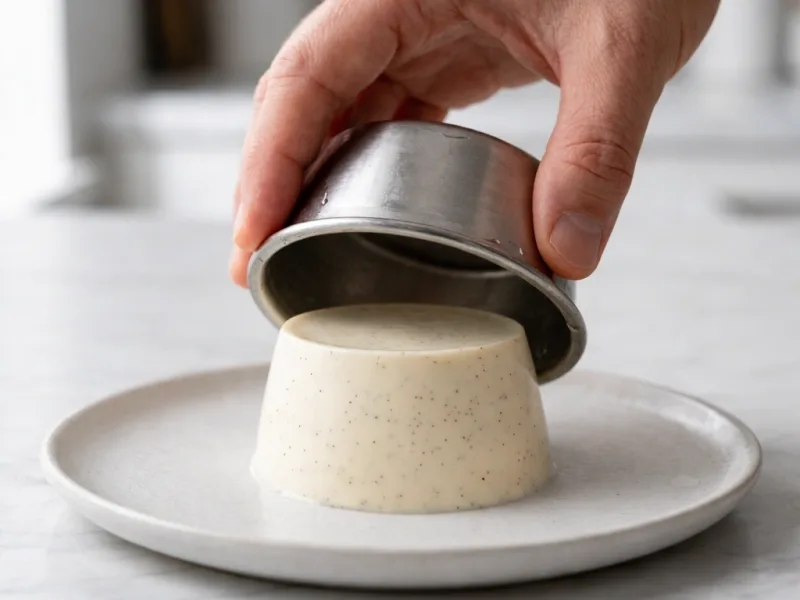
Precision technique for clean panna cotta unmolding
The final stage of preparing panna cotta—removing it from the mold—is essential for achieving a clean shape and stable texture, as established in the Panna Cotta Recipe. While the setting process defines structure, unmolding determines whether that structure is preserved or damaged.
Panna cotta relies on a gelatin-based network that holds liquid cream in a semi-solid form. This network is stable when fully chilled, yet sensitive to temperature and pressure changes. Improper release disrupts the outer layer, causing tearing, collapse, or deformation.
Understanding how to unmold panna cotta without breaking it requires precise control of adhesion, temperature, and timing. This technique transforms a correctly set dessert into a refined plated result with smooth surfaces and defined edges.
Step-by-step method to unmold panna cotta safely
To remove panna cotta from mold cleanly, ensure it has fully set for at least 4 hours at 39 °F (4 °C). A stable gel structure is required before any manipulation begins. Briefly dip the mold into warm water for 5–10 seconds to soften only the outer layer.
Place a flat plate over the mold and invert in one controlled motion. Apply slight downward pressure to break the vacuum seal, allowing gravity to release the panna cotta. This controlled method defines how to unmold panna cotta consistently without structural damage.
Why panna cotta sticks to molds
During chilling, the liquid mixture conforms tightly to the mold surface, creating near-complete contact. As it sets, slight contraction increases adhesion and forms a weak vacuum between the dessert and the mold wall. This is the primary reason panna cotta stuck in mold occurs.
Smooth, non-porous materials such as ceramic or glass intensify this effect. The absence of air pockets prevents natural release, requiring external intervention. Without proper technique, the panna cotta remains attached even when fully set.
How controlled heat enables release
Applying gentle heat weakens the bond between the panna cotta and the mold. The outermost layer softens slightly, reducing friction while the inner structure remains stable. This targeted softening allows clean separation without altering the overall shape.
Excessive heat disrupts the gelatin structure, causing the edges to liquefy. This results in loss of definition and potential collapse after unmolding. Controlled exposure ensures that only the interface layer is affected.
Scientific behavior of gelatin during unmolding
Gelatin forms a three-dimensional network that traps water and fat molecules within the cream mixture. At low temperatures, this network remains stable and elastic. When exposed to mild heat, the outer bonds begin to relax, reducing rigidity at the surface.
This localized softening explains why short warm-water immersion is effective. The internal structure remains intact because heat penetration is minimal. Understanding this mechanism is essential for consistent and repeatable results.
Mold materials and their effect on release
Different mold materials influence both adhesion and heat transfer. Silicone molds allow mechanical release through flexibility, eliminating the need for heat but often producing softer edges. Ceramic and glass molds provide a firmer shape but require precise temperature control.
Metal molds conduct heat more efficiently, allowing faster and more even release. However, they also increase the risk of overheating if immersion time is not controlled. Selecting the appropriate mold directly affects both technique and final presentation.
Practical applications in plated desserts
Mastering how to remove panna cotta from mold is essential in professional plating where precision is required. Clean unmolding ensures the dessert maintains its intended geometry, allowing sauces and garnishes to be applied accurately.
This technique is used in layered desserts, tasting menus, and service environments where consistency is critical. Proper release improves workflow efficiency and reduces product loss. The method also supports variations such as infused panna cotta or molded multi-layer presentations.
Cultural and professional context
Panna cotta originates from Northern Italy, where it is traditionally served either molded or in simple containers. In professional kitchens, unmolding is preferred for plated service because it enhances visual clarity and portion control.
The transition from rustic presentation to refined plating requires technical precision. Mastery of unmolding reflects a deeper understanding of dessert structure and temperature management, which are fundamental in classical European pastry techniques.